
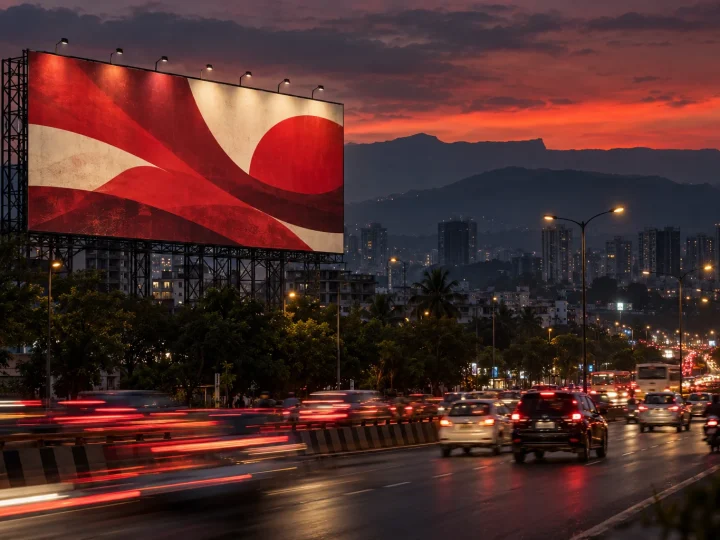
Hoarding printing is producing the large flex skin that is stretched over a steel frame on a building, a site boundary or a roadside structure. Because hoardings are usually wider than any single roll of flex, the print is made in panels and joined into one sheet before it goes up. 3 Red Media prints and joins hoarding flex at Chandni Chowk for builders, brands, institutes and events across Pune.
From design to a 40 ft skin: how a hoarding is made
A hoarding print goes through a few more steps than a normal banner:
- Size check. The frame size is confirmed, and extra flex is added on every side for lacing or wrapping round the frame.
- Panel plan. The design is split into vertical or horizontal strips that fit the material width. Seams are placed where they will not cut through a face, a logo or a phone number.
- Printing. Each panel is printed in order and checked for colour match, so the joins do not show a shift in tone.
- Joining. Panels are joined along an overlap, so the finished skin behaves as one sheet.
- Edge finishing. Eyelets or a reinforced hem with rope go round the edge, depending on how the frame takes the flex.
The result is a single skin you can lift onto the structure, rolled and folded carefully so it does not crease.
Hoarding sizes and what they cover
| Size (ft) | Area | Where you see it |
|---|---|---|
| 20 × 10 | 200 sq ft | Site boundary, building side, school wall |
| 30 × 15 | 450 sq ft | Highway frame, commercial building top |
| 40 × 20 | 800 sq ft | Large roadside structure, junction hoarding |
| Long strips, e.g. 60 × 8 | 480 sq ft | Construction site barricade wrap |
Measure the frame itself, not the space you think it covers. Old frames can be a few inches off their nominal size, and a skin made to the wrong measurement will either sag or not reach the lacing points.
Designing for a hoarding
A hoarding is read in two or three seconds, often from a moving vehicle on a busy road like the Mumbai–Bengaluru highway or Paud Road. Keep to about seven words of headline, one strong image and a short line of contact detail. A common sign-making rule is one inch of letter height for each ten feet of viewing distance, so a hoarding read from 200 ft needs letters around 20 inches high to be comfortable.
Resolution can be low for a hoarding, often 30 to 72 dpi at full size, because no one reads it from close up. What matters more is that the file has the right proportion. A 2:1 design on a 3:1 frame cannot be fixed by stretching.
Wind is the main enemy
A 30 × 15 ft skin catches as much wind as a sail. Pune’s monsoon, roughly June to September, brings gusts that tear loose hoardings and can bend weak frames. Hoardings in exposed spots need more care than most prints:
- Tight lacing at close intervals, so the load spreads across the edge instead of a few points.
- Wind cuts (small flaps cut into the flex) on large skins, which let air through and reduce the push on the frame.
- Mesh flex, a perforated material that lets wind pass, is used in some very exposed locations. It trades some colour density for lower wind load.
- A sound frame. A good print on a rusted or under-built structure is a safety risk, not just a cosmetic one.
Have the structure checked by the person or agency responsible for it before monsoon. The flex can be replaced; a falling frame is a serious hazard.
Who orders hoardings in Pune
Builders are the biggest users, wrapping site boundaries and putting up project hoardings that run for the whole construction period; see real estate hoarding printing. Schools and coaching classes book hoardings before admissions season. Political campaigns use them heavily around elections, under strict rules covered on the election banner page. Brands, malls and event organisers use them for launches and festival campaigns.
For long-running hoardings, star flex is a common step up from normal flex because it holds colour and detail better through months of sun.
Permission for hoardings in PMC and PCMC
Outdoor hoardings in Pune generally need permission from the municipal corporation, PMC within city limits and PCMC in Pimpri-Chinchwad. Unauthorised hoardings can be removed and fined, and the rules have been tightened in recent years. Getting permission, and putting up the hoarding on a permitted structure, is the advertiser’s or structure owner’s responsibility. Before you print, confirm the site is permitted. Our banner permission guide gives a general overview; for current fees and requirements, ask the corporation’s sky sign (advertisement) department or your ward office.
Changing a hoarding skin
Many hoardings change their design every few weeks or months. Since the frame stays, only the flex is replaced. Keep a note of the exact frame size and how the old skin was fixed, and the new skin can be made to the same pattern each time.
Ordering
Send the frame size, the location type (building, roadside, site boundary) and your design on WhatsApp. You get the price and a proof; nothing is printed until you approve. For big skins, ready time depends on size and the current queue and is confirmed before you decide. Delivery across Pune, PCMC and nearby cities is available, and installation can be arranged. You can also start from the quote form.