
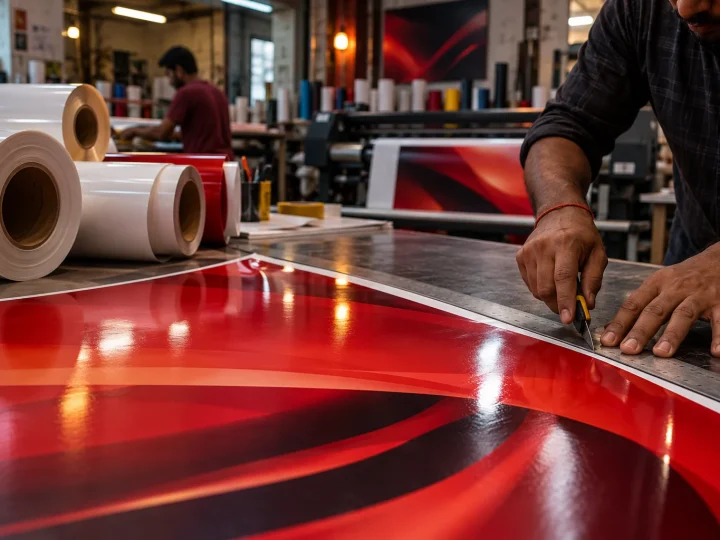
Vinyl printing means printing your graphic on a thin self-adhesive PVC film that you peel and stick onto a surface: glass, a painted wall, a sunboard, a car door. In Pune it is the go-to choice when a print must sit flat and sharp on something solid, rather than hang like flex. 3 Red Media prints and finishes vinyl at its own unit in Chandni Chowk.
Flex is a sheet that hangs or stretches. Vinyl is a skin that bonds. Most vinyl questions come down to two things: is the graphic printed or cut, and what surface is it going on?
Printed vinyl or cut vinyl?
Printed vinyl is white (or clear) self-adhesive film printed in full colour (in the trade, vinyl meant for outdoor use is usually printed with solvent or eco-solvent inks). It can carry photos, gradients and any number of colours. It is then cut square or trimmed around the shape of the design.
Cut vinyl is solid-coloured film that a plotter cuts into letters or shapes, with no printing at all. The waste is peeled away and the letters are lifted on transfer tape and applied. It gives very crisp lettering for shop timings, door names and vehicle text, but only in flat colours.
| Printed vinyl | Cut vinyl | |
|---|---|---|
| Colours | Unlimited, photos and gradients | One colour per layer |
| Look on glass | A full sticker panel (or clear film) | Just the letters, glass shows between them |
| Best for | Posters, wall graphics, product images, branding panels | Names, timings, phone lines, simple logos |
| Fine detail | Good | Very thin strokes can lift; keep text bold |
Where vinyl printing gets used
The same material does very different jobs depending on how it is finished. Each of these has its own page:
- Vinyl stickers and labels, square or cut around the shape.
- One-way vision film on shop and office windows, printed outside and see-through from inside.
- Vinyl mounted on sunboard for rigid indoor boards, signs and cut-outs.
- Wall graphics for offices, clinics, cafés and classrooms.
- Vehicle lettering and branding on cars, vans and delivery fleets.
Shop owners use vinyl a lot on glass: timings on the door, an offer on the window, a logo on the counter front. Clinics and offices use it for room names and privacy bands. You can see how these come together on the shop branding page.
Lamination: when it is worth adding
A clear laminate over printed vinyl protects the ink from scratches, cleaning and sun. It also changes the finish. Gloss lamination makes colours look richer but can reflect light. Matt lamination cuts glare, which helps when a print sits under shop lights or near a window.
- Add lamination for anything that will be touched, wiped or walked past often.
- Add it for outdoor vinyl facing strong sun, such as a west-facing shop window.
- Floor graphics always need a textured anti-slip laminate, not ordinary gloss.
- Short-term indoor stickers can usually skip it.
White, clear or frosted: picking the film
Not all vinyl is white. The base film changes how the finished piece looks, especially on glass.
- White vinyl is opaque. Colours look true and nothing behind shows through. This is the default for walls, boards and most stickers.
- Clear vinyl is transparent, so only the printed parts show. It suits logos on glass where you want the glass to stay visible around them, though light colours look weak on it.
- Frosted film gives an etched-glass look for privacy on cabins and washroom windows, and it can be cut into patterns. See frosted glass film.
- Perforated film is the base for one-way vision on windows.
If you are not sure which base suits the spot, send a photo of the glass or wall along with the size. It is much easier to suggest the right film when we can see the light and the background.
Measuring for vinyl
Because vinyl goes onto a fixed surface, measure that surface, not the frame around it. For a glass door, measure the visible glass inside the frame and leave a small margin. For a wall, measure the area you want covered and note any switches, sockets or windows. Size is given in feet and inches, and area in sq ft: a 6 × 3 ft window is 18 sq ft.
For glass, tell us whether the vinyl goes on the inside or the outside. A print on the inside of the glass has to be printed mirror-reversed to read correctly from the street.
Surfaces: what vinyl sticks to well
| Surface | How it behaves |
|---|---|
| Glass | Excellent. Clean with water or spirit before applying. |
| Smooth painted wall (enamel or plastic paint) | Good, once the paint has fully cured |
| Textured or powdery wall paint | Poor grip. A sunboard or framed print may be the better option. |
| Sunboard, ACP, acrylic | Very good. Used for rigid boards. |
| Vehicle paint | Good on clean, waxed-free paint; deep curves need the right vinyl type. |
Artwork for vinyl
Vinyl is often seen closer than flex, from a few feet away on a door or a wall, so files need a bit more resolution: around 150 dpi at full size is a safe target. For cut vinyl, the design must be in vector form (CDR, AI, PDF or SVG) because the plotter follows lines, not pixels. A JPG logo can be redrawn, but tell us in advance.
Indoors, outdoors and the Pune weather
Indoor vinyl in a shaded spot can stay looking fresh for a long time. Outdoors, the main threats are strong summer sun on south- and west-facing glass, dust, and harsh cleaning. Edges are the weak point: once an edge lifts, dust gets under it. A good clean surface at the time of fixing and a laminate on top make the biggest difference. Not sure whether to use vinyl or flex for an outdoor job? See flex vs vinyl.
How a vinyl order runs
Send the size, the surface and your design or text on WhatsApp, and mention whether it is printed or cut, indoor or outdoor. You get a price and a digital proof, and printing starts only after you approve. Vinyl can be collected from Chandni Chowk or delivered across Pune and PCMC, and application on site can be arranged. You can also use the quote form.