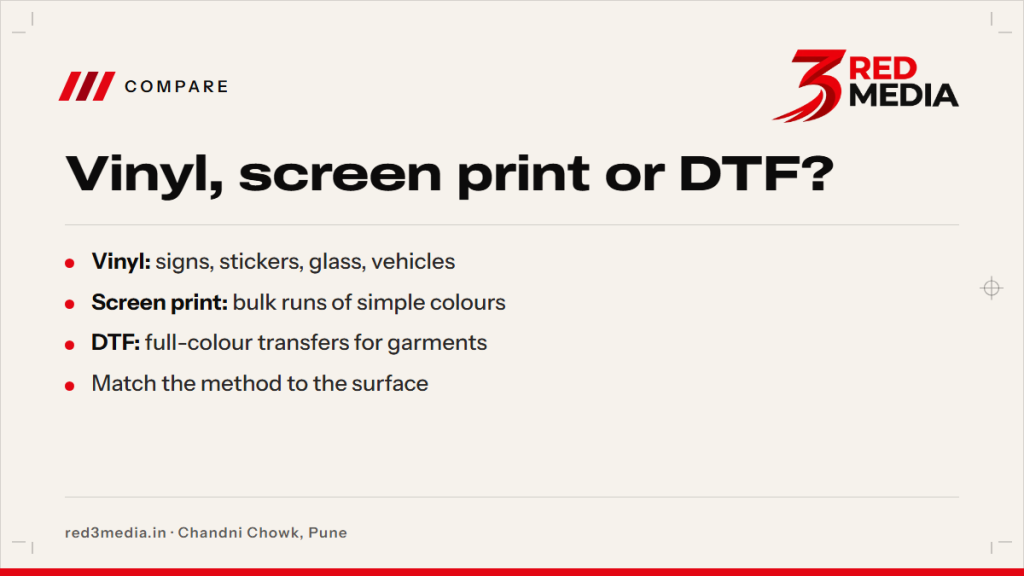
Vinyl printing vs screen printing depends on what you are making, what surface it goes on and how many you need. Vinyl suits signs, stickers, glass and vehicle graphics; screen printing is commonly used for bulk runs of garments or other items with simple colours.
DTF is another garment decoration method: it transfers a printed design from film onto fabric. It is different from sign vinyl and from screen printing, so first match the process to the material. At 3 Red Media’s print unit in Chandni Chowk, we print vinyl for signs and graphics; for garment printing, ask us whether it can be arranged for your job.
What is the difference between vinyl printing and screen printing?
Vinyl printing uses printable film to produce a graphic that can be cut to size and applied to a surface. It is a practical fit for flat signs, window graphics, stickers and vehicle branding. The material and finish should suit the place it will be used, including whether it faces rain, handling or strong sunlight.
Screen printing pushes ink through a prepared screen onto a surface, often one colour at a time. Each colour needs its own setup, so the method is often considered for larger quantities of similar designs. It can suit repeat designs with a limited colour palette, but the screen setup takes preparation.
In short, vinyl is a printed or cut film applied to a surface, while screen printing places ink directly onto the item. They are not interchangeable for every job. A window sticker, for example, needs a material made for glass application; a run of matching garments may suit a garment printing process instead.
What is DTF printing and how does it differ from vinyl?
DTF means direct-to-film. A garment design is printed onto transfer film and then pressed onto fabric. It can carry detailed, multicolour artwork, which is why people compare DTF with cut garment vinyl and screen printing when planning T-shirts or uniforms.
For this comparison, keep the surfaces clear: sign vinyl is made for graphics on surfaces such as glass, boards or vehicles, while DTF is a garment transfer process. If you are comparing garment methods, consider the fabric, artwork detail, feel, quantity and how the item will be washed. Ask the print provider which method they actually offer for that material.
Which is best for signs and stickers?
For signs and stickers, vinyl is usually the relevant choice among these three. Screen printing and DTF are associated with printing on items or garment transfers, not making a large-format vinyl graphic for a shop window or vehicle. Vinyl can be printed as a graphic, or cut into lettering and simple shapes.
The exact vinyl and application depend on the job. Glass graphics may need a different approach from a board sign, and a vehicle has curves, joins and edges to plan around. Send the finished size, where it will go and the artwork so the material and layout can be discussed. See what vinyl printing involves and our vinyl printing service in Pune.
For a shopfront, also check any permission requirements that may apply with your ward office. Requirements can depend on the location and installation. For a shop or office board in Maharashtra, confirm current signboard rules with the relevant ward office before production.
Which is best for T-shirts and uniforms?
For T-shirts and uniforms, the choice depends on garment fabric, artwork and quantity. Screen printing is often considered for larger matching runs with simple colours. DTF is often considered for detailed, full-colour garment designs. Cut garment vinyl is another process for simple shapes or lettering, but it is not the same as large-format sign vinyl.
Ask about garment printing only after confirming the fabric and design can be handled by the provider. For uniforms, also think about placement, repeatability and care instructions. We print vinyl graphics for signage and related surfaces; for garment printing, ask us whether it can be arranged for your job.
Which suits small quantities and which suits bulk?
Small quantities can favour a method with little setup for each design, but the answer still depends on the product. Vinyl works well for a few signs, window graphics or custom stickers. For garments, DTF may suit smaller quantities with detailed artwork, while screen printing is often weighed up for bigger runs of the same design.
With screen printing, setup is repeated when colours or artwork change, so a larger matching order can make that preparation more worthwhile. With vinyl signage, size, material use, cutting and finishing matter more than garment quantity. Compare like with like: one large window graphic is not equivalent to a hundred small shirt prints.
| Job | Method to compare | What to check |
|---|---|---|
| Shop window or wall graphic | Printed vinyl | Surface, size and exposure |
| Matching garments with simple colours | Screen printing | Quantity and colour count |
| Detailed garment artwork | DTF transfer | Fabric, placement and care |
| A few custom stickers | Vinyl printing | Shape, finish and application |
Which should a shop or office use for branding?
For a shop or office, choose by where the branding will appear. Window hours, a reception sign, wall graphics, a vehicle logo and staff uniforms may each need a different process. Vinyl can cover many signage surfaces, while garment methods are for clothing. There is no single choice for every branded item.
Measure the available space and note whether the graphic is indoors or outdoors. In Pune, monsoon weather from June to September can affect exposed signs, and harsh afternoon sun can fall on west-facing glass. Share that use information when asking about materials. For a broader comparison of sign materials, read flex versus vinyl.
Send a clear design file and the finished size. If you have not prepared artwork yet, check how to send artwork. We quote from the details, share a digital proof and wait for your approval before printing. If fabrication, electrical work or installation is needed, send the size and ask whether it can be arranged for your job.
Delivery is available across Pune and PCMC, and courier can be arranged elsewhere in India with the courier charge added to the quote. Share the delivery location along with the dimensions and artwork so it can be included in the job discussion. Send your size and design for a quote.