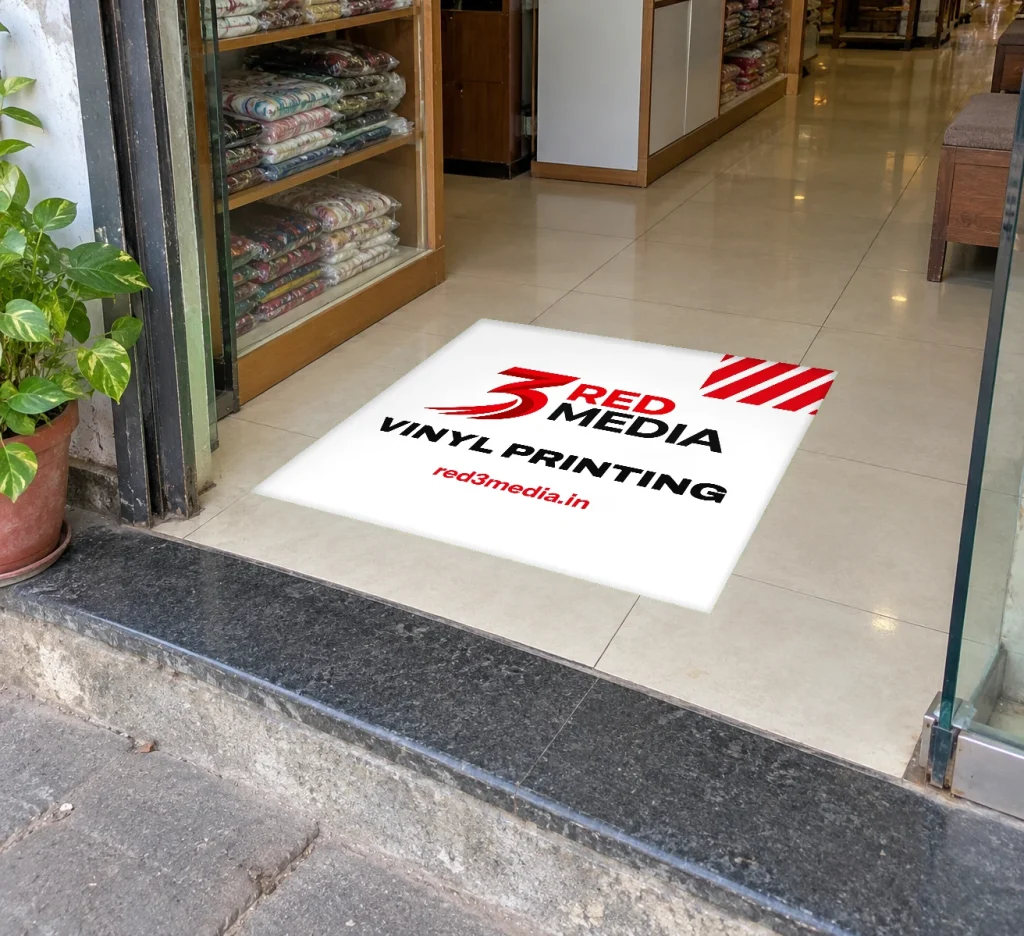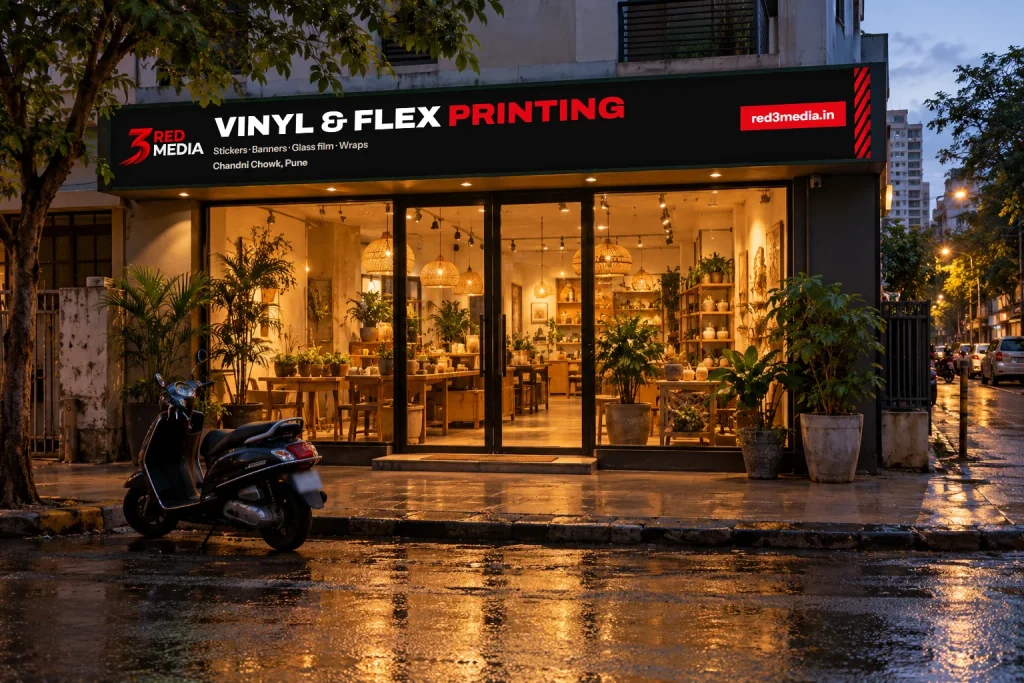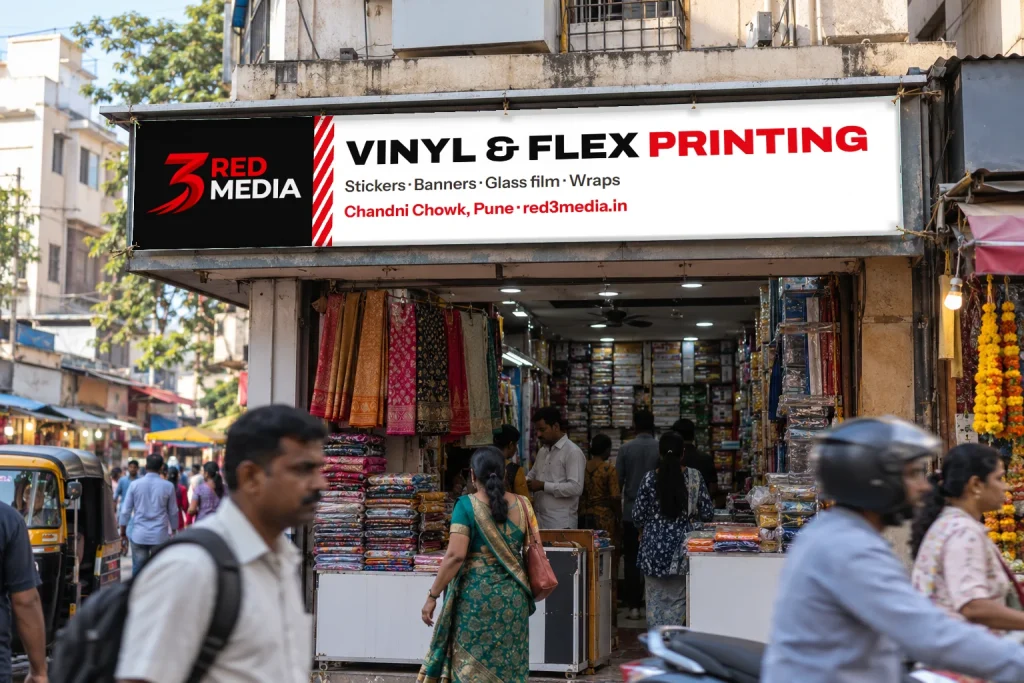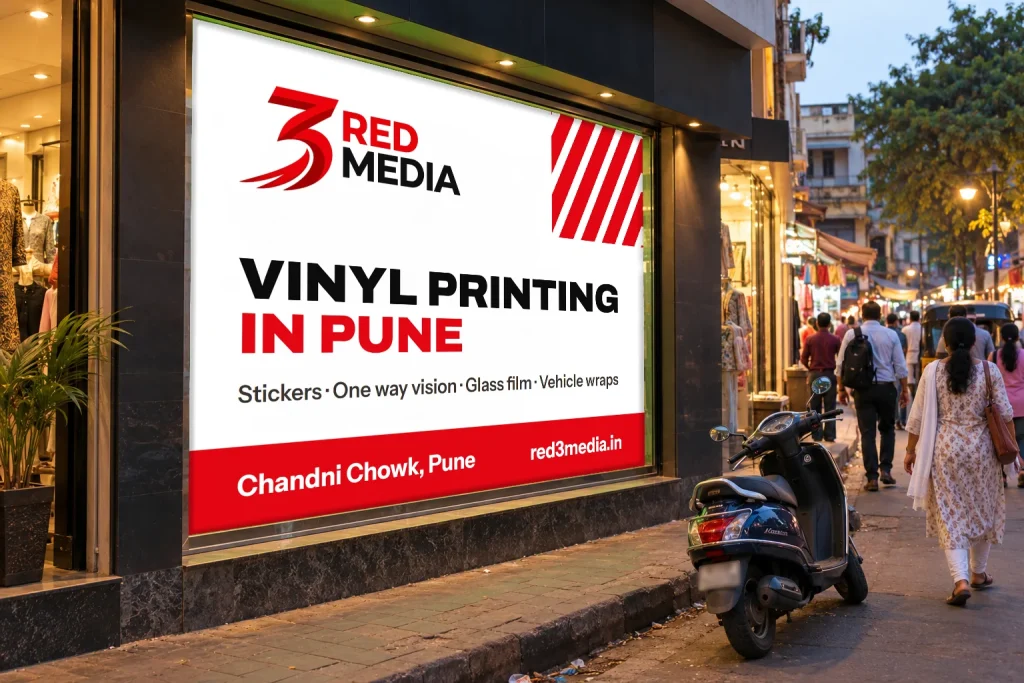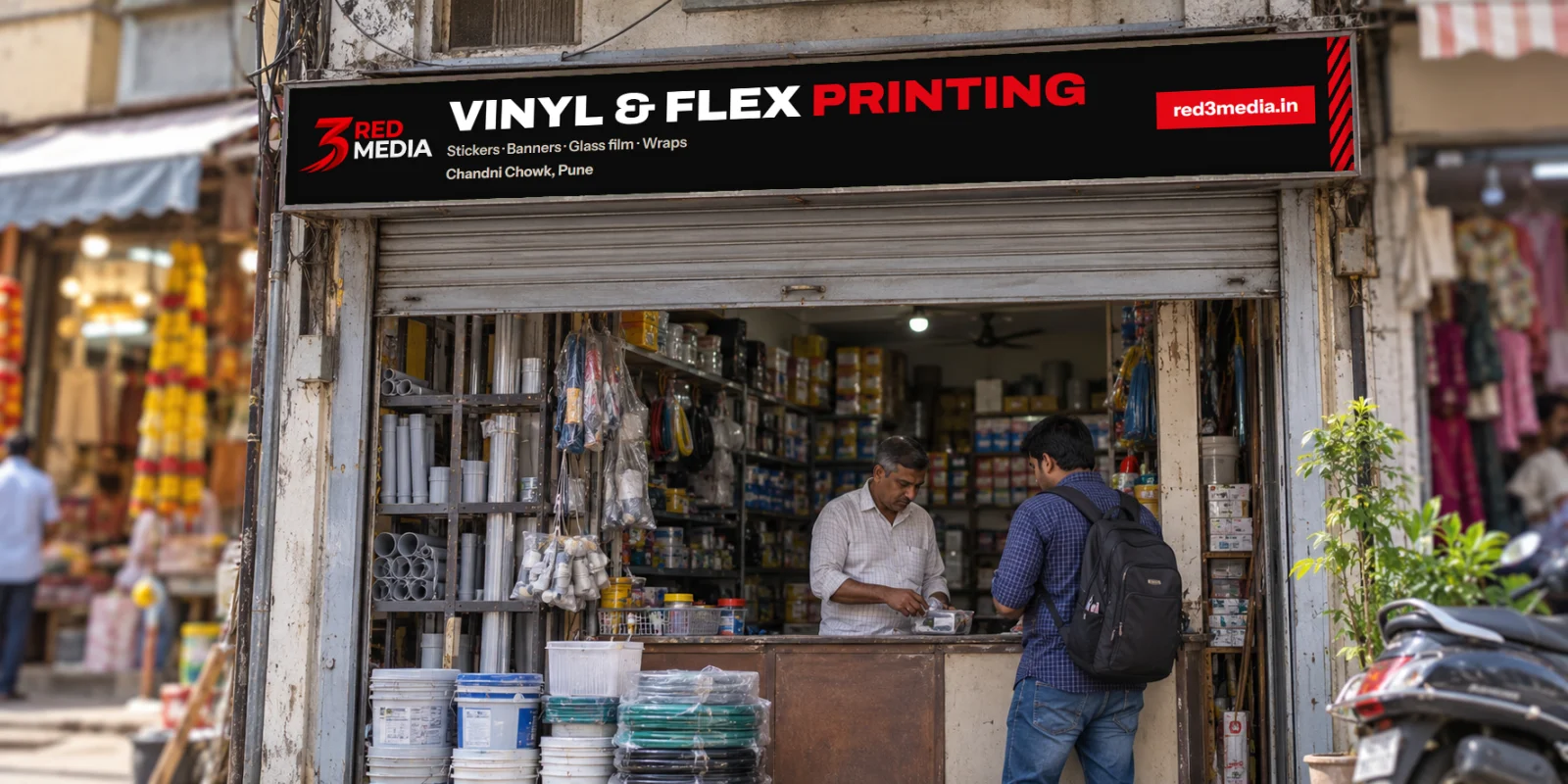
Low budget shop branding works best when the money goes to the two things every passer-by sees first: the shop board and the glass. After those, one logo and two colours repeated on stickers, bags and the counter make a small shop look like one business. Walls, floors and extra signs can wait for a better month.
Printed vinyl suits a tight budget because it is priced by the area you use. A name on the glass is a small piece, a sticker is smaller still, and any of them can be reprinted alone when an offer or a number changes. That is why shop branding on a budget usually starts with vinyl.
How can a small shop do low budget shop branding?
Spend in the order customers look. Someone crossing the road reads the board, then the glass at eye level, then the counter and the bag they carry out. Walls and floors come last.
| Order | What it does | |
|---|---|---|
| 1 | Name board | Says who you are and what you sell |
| 2 | Glass lettering | Timings, Open, UPI and offers at eye level |
| 3 | Counter strip | Makes the billing area look organised |
| 4 | Stickers for bags and boxes | Puts the logo in the customer’s hand |
| 5 | Inside wall or floor | Later, when sales allow |
Before asking for any quote, measure the board space and each glass pane, and photograph the front from across the road. Those three facts let a printer price the work without guessing.
Which print gives the most impact for the money?
Compare areas, because area is what you pay for. A 10 x 3 ft name board is 30 sq ft. A glass band 6 ft wide and 1 ft high is 6 sq ft. A sheet of 40 stickers, each 2 x 2 inches, is only about 1 sq ft. Lettering on the glass is the cheapest way to be read, because everyone who walks in passes it, including people who never look up at the board. Stickers are the cheapest way to be remembered. The vinyl sticker printing page covers sizes and finishes.

Outdoors, the board and the glass face the sun and the monsoon, so ask for outdoor-grade vinyl with a laminate. Choosing the right film once costs less than replacing a faded board.
Is a shop board or glass vinyl the better first spend?
If the board is readable, even if faded, start with the glass. If you have no board, or yours sits among five identical ones, the board comes first. Either way, set the board up correctly while it is being made, because a wrong one costs more to redo.
Two rules touch name boards in Maharashtra. The state’s Shops and Establishments Act, amended in 2022, asks for the shop name in Marathi in Devanagari script (Section 36A), and published summaries say small shops with fewer than ten workers are covered too. A GST-registered shop must also show its GSTIN on the board (CGST Rule 18). Confirm both with your ward office or accountant, and see sign board printing for the builds.
How can I reuse one design across stickers, boards and bags?
Keep one brand sheet: the logo as a vector file (CDR, AI, PDF or SVG), two colours written down with their codes, and one font. Everything is then cut from the same set. The board carries the name large, the glass band repeats it with timings, a 2-inch round sticker closes bags and boxes, and a strip on the counter shows the UPI code. A vector logo prints sharp at any size and saves redrawing it each time, so ask for it on day one.
What should I skip when the budget is tight?
- Glow boxes and lit letters, until evening sales justify them.
- Opaque vinyl across the whole window. The shop looks shut and dark inside, and a band or lettering at eye level does the work.
- Long product lists on the board. Name and trade line first, and the rest on the glass.
- Dated offers printed on the board. Keep dates on a small strip so only the strip is reprinted.
- Unlaminated stickers outdoors, which scuff and fade sooner.
- Odd-shaped stickers in small runs. A square or a circle uses the sheet better.
- Three fonts and four colours. They cost the same to print and look cheaper.
- Your neighbour’s colours. On a lane where every board is red and white, pick a colour the lane lacks.
How do I grow branding step by step?
- Month one: the name board and the glass lettering.
- Next: a counter strip, and stickers for bags, boxes and packets.
- Then: category signs inside, on sunboard or vinyl, so customers find things without asking.
- When sales allow: a wall print behind the counter, floor arrows for the queue, and a glow board if you trade after dark.
- Throughout: keep the files, so each new piece starts from the same layout and colours and matches the last.
The shop branding printing page lists every part of a shop front. 3 Red Media does its printing at Chandni Chowk, Pune, and a photo of your shop front, the board size and your logo sent through the quote form are enough to start a proof.