
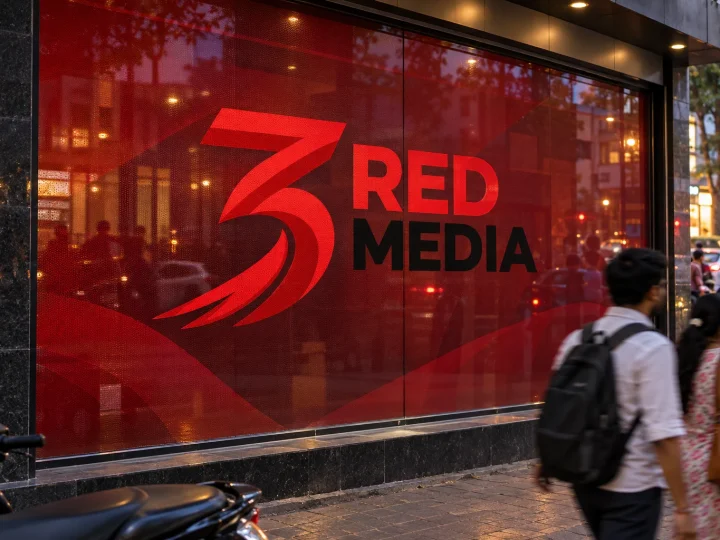
One way vision in Aundh suits the shops and branches whose glass is only a footpath away from the people reading it. ITI Road, DP Road and Parihar Chowk are walked, not driven, so passers-by see the glass at arm’s length and from across the road. The film puts a printed face on it for them and a tinted, usable view behind it for the people inside. Up close you can see the build: a printed white face, a dark layer behind it and a fine grid of holes through both, so the street reaches the inside dimmed.
Boutique frontage on ITI Road
Frontages on ITI Road tend to sit in older buildings, where each pane is a different size and a beam or an air-conditioner interrupts the glass. A mismatched front can look tidy again when one band of film runs across every pane in the same colour and the same height. The eye reads one board, not five odd windows.
Put the heaviest part of the picture where hands and eyes land, between about 4 and 6 feet from the pavement, and leave a calmer colour above and below. A boutique that changes its look for the wedding season or a sale can keep the band and replace only the central panel.
Sun and rain are the two things to plan for. A front that faces the afternoon sun will fade sooner than one in shade, and a laminate helps. Monsoon rain leaves the vinyl untouched but streaks the view out, so wipe the pane once it is dry instead of during the shower.
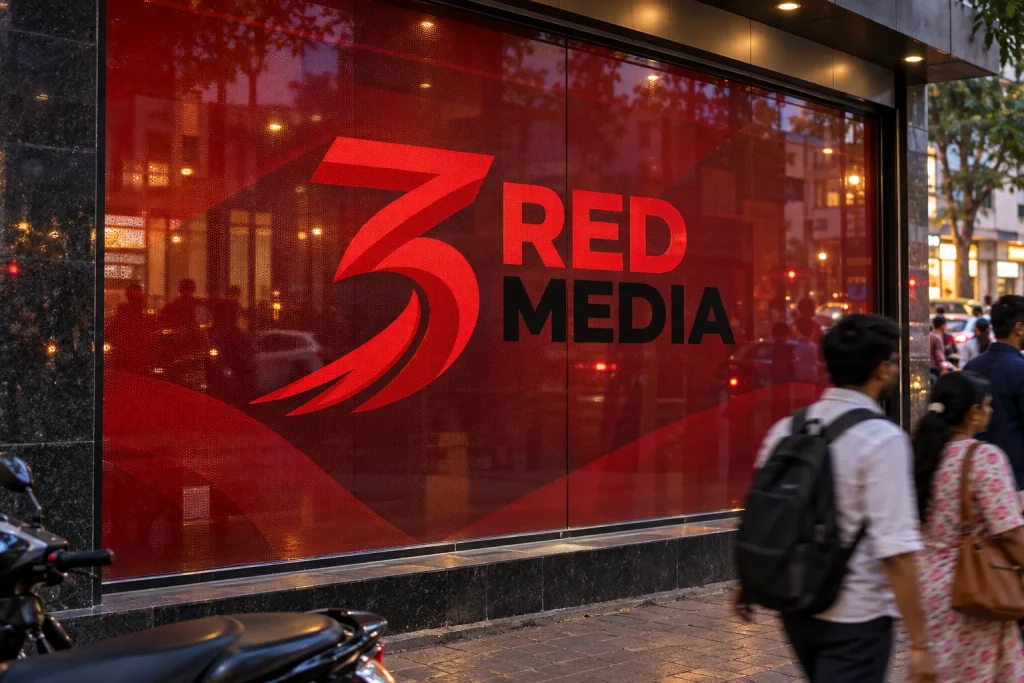
Bank branches and ATMs at Parihar Chowk
A bank branch normally follows a brand manual from its regional or head office, so the film has to carry approved artwork and nothing improvised. Send the file the bank gave you with the exact pane sizes, and the proof shows it on your own front before anything is printed. Keep the door glass for branch hours and notices in cut vinyl, since small figures do not survive the holes.
ATM lobbies at the chowk face the same pavement. In daylight, the film softens glare on the screen and shields the keypad from the street. Whether the glass may be covered at all is the bank security team’s decision, because cameras and guards need their sightlines.
| Item | Who decides | What to send them |
|---|---|---|
| Branch frontage graphic | The bank, usually at regional or head-office level | The approved artwork and a proof on your photo |
| ATM lobby glass | The bank security team | Pane sizes and the camera positions |
| Anything on the building facade | The owner or the society | The proof and a plan for removal |
Salon front glass in Aundh’s busy lanes
A salon can show its offers outward on one way vision film while clients stay out of sight from passers-by during the day. Wash stations and treatment chairs near the window are the usual worry, and by daylight the film handles them.
The lanes are narrow, so people pass within a step of the glass. At that distance the printed dots and the holes are visible, which means the design has to look right at three feet and at thirty. Large flat shapes do both jobs; fine gradients do neither. Hands touch salon glass all day, so a laminate keeps fingerprints easier to wipe.

How to order one way vision in Aundh
Photograph the front twice, straight on and from an angle that shows the beam and the units, and mark the pipes and wires on the photo. Measure each pane inside its frame. Parking on ITI Road is tight in the daytime, so tell us if an early or side-lane delivery suits; the film comes up from Chandni Chowk through Pashan or Baner. The proof reaches you on WhatsApp, and nothing is printed before you agree to it. Fitting can be arranged for upper floors.
The shops’ other vinyl work is listed under vinyl printing in Aundh, and the Pimple Saudagar side of the river is served through vinyl printing in Pimple Saudagar. For how the film itself behaves, read the guide to one way vision in Pune. To get a figure, request a quote with the photos and sizes.