Applying vinyl in humid weather works as long as the surface itself is dry. The air can be thick with monsoon moisture; what the adhesive cannot tolerate is a film of water, a damp wall or dew on the glass. Pass a simple dryness test, fit in a dry spell, and vinyl usually sticks well even in July.
Pune’s monsoon, roughly June to September, brings two problems that work against fitters: moisture inside walls and sudden showers. Both can be planned around.
Is applying vinyl in humid weather a bad idea?
Not by itself. Vinyl adhesive bonds to a clean, dry surface, and most monsoon days in Pune sit inside the temperature range film makers give for fitting, so heat or cold is rarely the problem. Humidity matters for what it does to the surface. A cool glass pane beads with water, a bathroom wall stays clammy, and a mopped floor holds moisture for hours. Air-conditioned rooms add a hidden case: when the AC switches off, warm humid air condenses on the cold glass and walls.
The working rule is simple: the air may be humid, but the surface must be dry.
Why does humidity make vinyl peel or bubble?
Applying vinyl in humid weather goes wrong in four ways, and each leaves a different sign.
- A water film on the surface. The adhesive grips the moisture instead of the wall or glass, so the bond is weak from the start.
- Damp moving through a wall. Moisture rising or seeping in from outside pushes against the film and lifts it, usually near the skirting or a corner.
- Trapped fitting water. On glass, the soapy water used to slide the film into place must be squeezed out to the edges, and it clears slowly in humid air.
- Slow-drying ink or paint. Prints need time to dry before lamination, and new paint needs weeks to cure. Damp air stretches both.
Bubbles that appear a day later usually come from the last two causes, while edges that lift after the first rain come from the first two.
How do I check if a wall is dry enough for vinyl?
- Look and touch. Dark patches, a cool clammy feel, blistering paint or white salt powder mean moisture is moving through the wall.
- Tape a square of clear polythene, about 1 ft across, to the wall on all four edges and leave it for a day. Droplets under the sheet, or a darker wall behind it, mean the wall is not ready. A moisture meter gives a number if you have one, but this test needs no equipment.
- Check the other side. A wall that backs onto a washroom, a kitchen or an outside face will take on damp again after every heavy rain.
- Wait for a run of dry days, then repeat the test before the print is ordered.
Quick check: press your palm flat on the wall for ten seconds. If it comes away cool or faintly damp, the wall needs more time.
Paint and surface rules for murals are covered under wall graphics.
What time of day suits applying vinyl in humid weather?
Late morning to mid-afternoon on a dry day. Early morning carries dew, especially on glass and metal, and humidity climbs again as evening cools the air. Look at the forecast the day before and fit when the next day or two look dry.
| Job | Fit when | Avoid |
|---|---|---|
| Glass, outside face | Late morning, once dew has gone | Rain, mist, wet panes |
| Glass, inside face | Any hour the glass is dry, even on a wet day | Water left to pool |
| Painted wall | After several dry days | A wall that feels cool or sweats |
| Car or bike | Under cover, in daylight | Open parking in drizzle |

How do I protect outdoor vinyl during the first days?
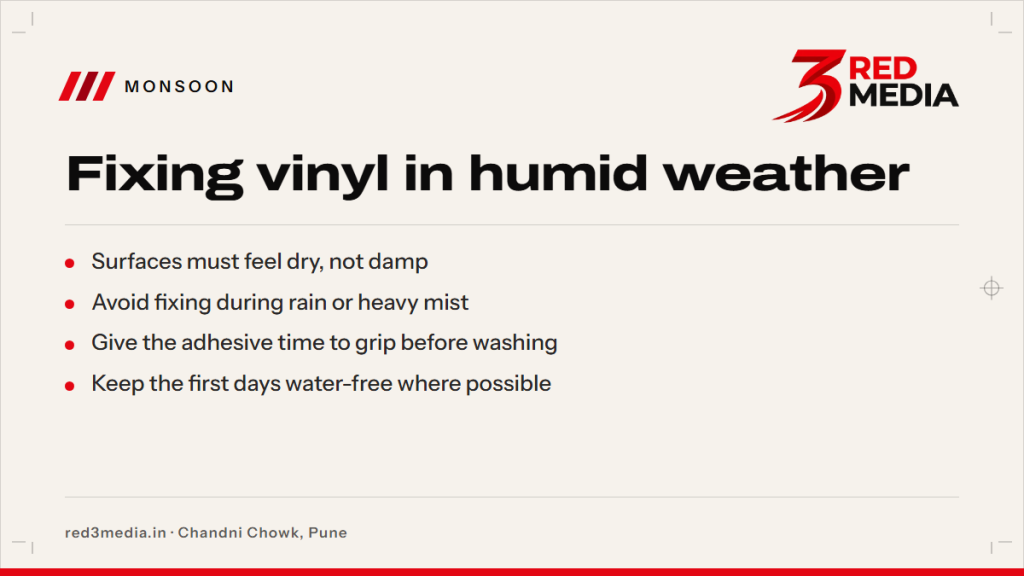
After applying vinyl in humid weather, the first two days decide how well it holds, because the adhesive keeps gripping harder for that long.
- Press the edges down again a few hours later, and once more the next day.
- Keep water off for the first two days where possible. A wrapped vehicle should stay under cover and skip washing until the fitter says it is safe.
- Never aim a pressure washer at an edge.
- Walk the job after the first rain and press down any corner that has lifted. A small lift caught early is easy to fix, but the same lift left alone spreads.
Outdoor life in general, and what shortens it, is covered in how long vinyl lasts outdoors.
Which jobs should wait until the rain stops?
- Exterior walls that show damp stains, and any wall painted in the last few weeks.
- Full vehicle wraps, which need a clean, dry, shaded bay; vehicle branding explains the options.
- Floor graphics on floors that are mopped daily or stay damp.
- Large outdoor glass facing the weather, unless the film can go on the inside face.
Only the fitting has to wait. Vinyl printing can be proofed, printed, dried and laminated during the rains, then stored flat in a dry room until the first clear week.
3 Red Media prints at its Chandni Chowk unit in Pune, and fitting can be arranged for a dry window. Send the surface, the size and a photo through the quote form. Applying vinyl in humid weather goes better when the brief also says whether the wall has shown damp in past monsoons.