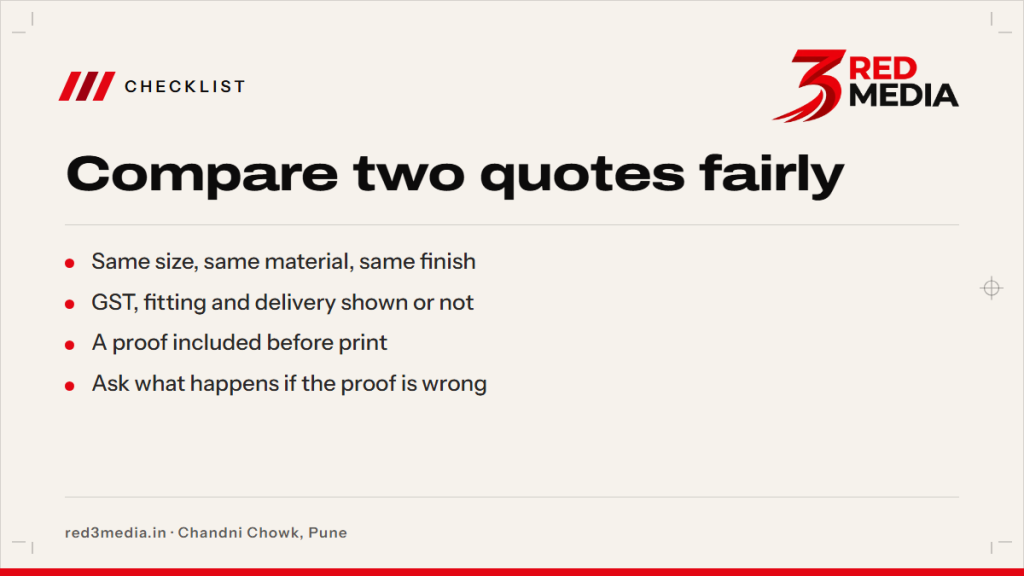
To compare printing quotations, check that both quotes cover the same size, material, finish and services. A lower total may leave out lamination, cutting, fitting, GST or delivery, so compare each line before choosing.
For a fair comparison, send the same dimensions and artwork to each printer, then ask for a written breakdown. At 3 Red Media, our print unit is at Chandni Chowk, Pune, and we send a digital proof for approval before we print.
How do I compare printing quotations properly?
Start with the job brief. Write down what the printed item is for, where it will be used, how many pieces you need and whether you need printing only or additional work. Share the same brief with every printer so the quotes have a common basis.
Then compare the quote line by line, not just the final amount. Note any item marked extra, excluded, optional or subject to confirmation. If a quote uses a general description such as “vinyl print”, ask what material and finish that means for your job.
For a quick check, use the same checklist for each estimate. You can also review our vinyl printing price guide for Pune to see which job details affect a vinyl estimate.
What should a printing quotation include?
A useful printing quotation identifies the product, quantity, dimensions, material, print area and finishing requested. It should also make clear whether artwork preparation, cutting, packing, fitting, transport and taxes are included or listed separately.
The table below gives you a simple comparison format. Fill it in from the written quotes, then ask the printer to clarify anything that is blank or unclear before you decide.
| Item to compare | Quote A | Quote B |
|---|---|---|
| Product and quantity | Same item and count? | Same item and count? |
| Finished size and print area | Dimensions stated? | Dimensions stated? |
| Material and finish | Type and lamination stated? | Type and lamination stated? |
| Cutting or finishing | Included or extra? | Included or extra? |
| GST, fitting and delivery | Shown or excluded? | Shown or excluded? |
| Proof and approval | Digital proof process stated? | Digital proof process stated? |
Is the quoted size the same in both quotes?
Check the width and height, and confirm whether they refer to the finished piece or the full sheet before trimming. Write dimensions in feet and inches where that is how you measured the site, and check the area in sq ft if the quote is area-based. For example, 4 ft by 3 ft is 12 sq ft.
For a set of stickers or labels, compare the size of each sticker, the number of pieces and the sheet or roll arrangement. For a wall graphic or banner, check whether the estimate covers one complete graphic or multiple sections. Ask how seams, borders or trimming affect the final dimensions.
A small difference in the stated size can change material use and finishing. If your dimensions are approximate, label them as approximate and ask the printer to confirm the final size before production.
Are material, lamination and finishing the same?
“Vinyl” can describe different products for different uses. A quote for a window graphic may not specify the same material as one for a wall graphic or vehicle branding. Ask for the material description and intended use to appear in writing, and check our vinyl printing options if you are comparing common applications.
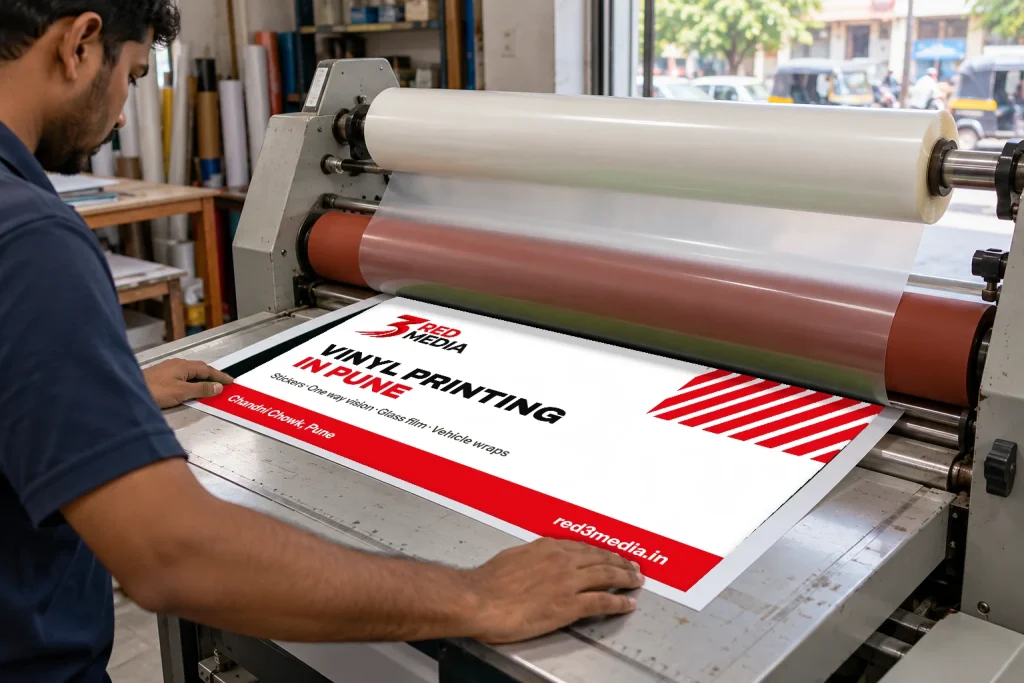
If one estimate includes lamination and the other does not, the totals are not directly comparable. Confirm the type of lamination or finish specified, and whether it applies to the full print area. Also ask whether trimming, contour cutting, eyelets or other requested finishing is included.
The same check applies when comparing flex printing with vinyl. Flex is used for some banner jobs, while vinyl is used for stickers, labels, glass graphics and other applications. Our flex printing price guide can help you identify the details to include in a flex enquiry.
Are GST, fitting and transport shown?
Look for a clear note showing whether GST is included in the total or added separately. Check whether delivery, packing, installation or fitting has a separate line, and confirm the delivery location used for the estimate. If any of these are not listed, ask whether they are included before comparing totals.
We deliver across Pune and PCMC. For courier delivery elsewhere in India, the courier charge is added to the quote. If you need fabrication, electrical work or installation, send the size so we can tell you whether it can be arranged for your job.
For shop signs, window graphics or other work in public-facing spaces, permission requirements can depend on the site and the local authority. Check with your ward office for applicable PMC or PCMC requirements rather than relying on a printer’s estimate as a permissions decision.
If you are sending the artwork with the enquiry, our guide to sending print artwork covers the details that help the printer prepare a useful estimate.
How do I judge a proof and a sample before approving?
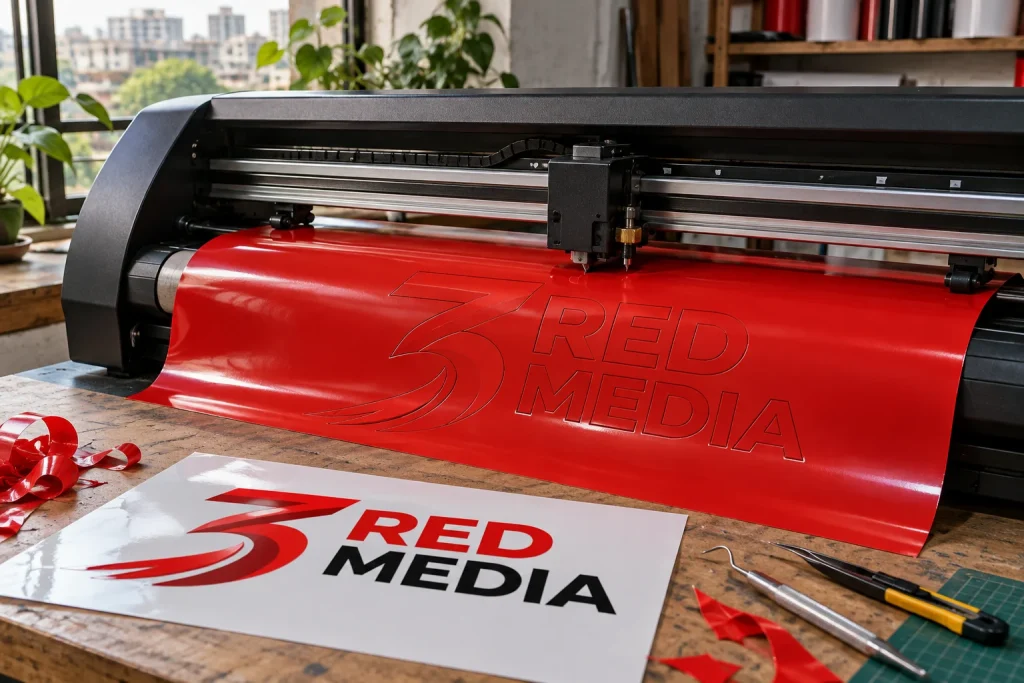
A digital proof lets you check the layout before printing. Confirm the wording, spelling, colours, dimensions, orientation and placement of important elements. For cut vinyl, review the cut shapes and spacing as well. Ask the printer what process they follow if the proof differs from the approved design.
A proof on screen cannot show every detail of the final material or finish. If colour or surface appearance is critical, ask whether a physical sample can be arranged for your job. Do not approve production until the proof matches the version and dimensions you intend to use.
To help prepare your quote, send the finished size, quantity, application, location and design file. Tell us which finish and fitting you need, if any. Use the quote form to share those details and receive a written estimate and digital proof for review.