Air bubbles in vinyl are pockets of trapped air between the film and the surface. Small bubbles can often be pushed to an edge with a squeegee, while larger or stubborn ones may need careful lifting and refitting.
The right fix depends on the vinyl, the surface and how long it has been fitted. These steps cover stickers, window film and wraps, with simple ways to avoid bubbles during application.
Why do air bubbles form under vinyl?
Air gets trapped when vinyl is laid down too quickly, pressed unevenly or applied over dust, grease, moisture or a rough surface. A surface can look clean but still have fine grit or residue that stops the adhesive making even contact.
The film itself matters too. A large graphic is harder to position in one go than a small sticker. On curved panels, the vinyl has to follow changes in shape, so tension or a poor fit can leave bubbles or creases.
Some bubbles are actually caused by water or other residue under the film, rather than air. Avoid trying to force them out before checking what is trapped, especially on window film where liquid may be part of the fitting method.
For a sticker job, see our vinyl sticker printing in Pune guide. The material and surface both affect how easily a sticker can be fitted.
How do I remove air bubbles from a vinyl sticker?
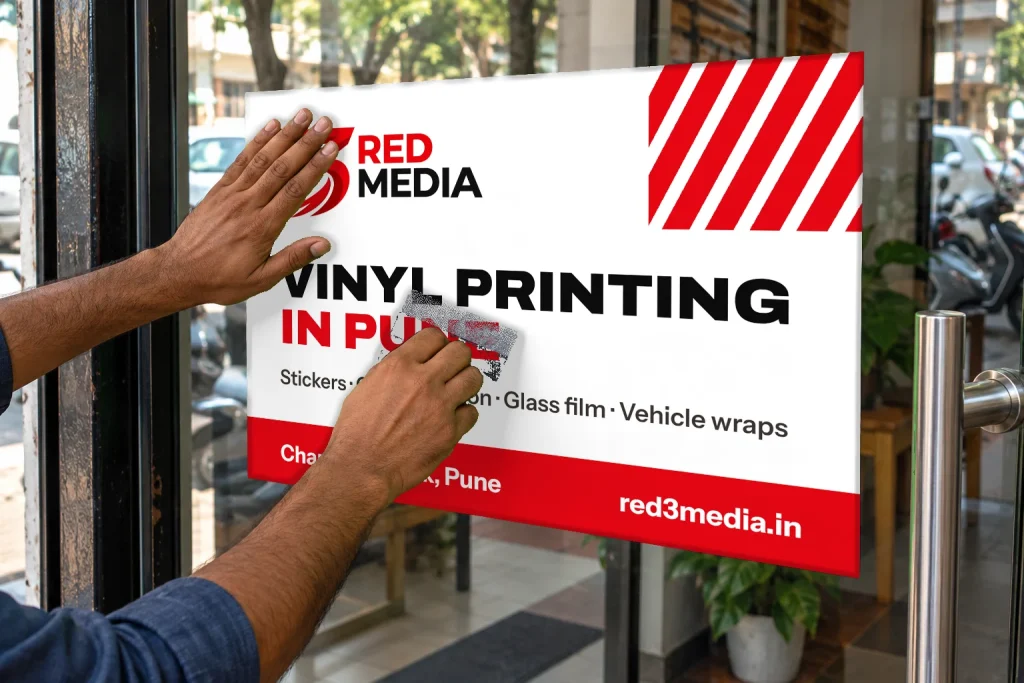
Start with a clean, dry surface and use a soft squeegee or a clean plastic card wrapped in a lint-free cloth. Press gently from the middle of the bubble towards the nearest edge, using short strokes. Do not scrape hard, as that can mark the print or stretch the film.
If the vinyl has not fully settled, a small bubble may move with light, even pressure. For a larger bubble, gently lift the nearest edge of the sticker just enough to let air out, then lay it back down while smoothing towards the edge. Stop if the vinyl begins to crease, tear or lose its shape.
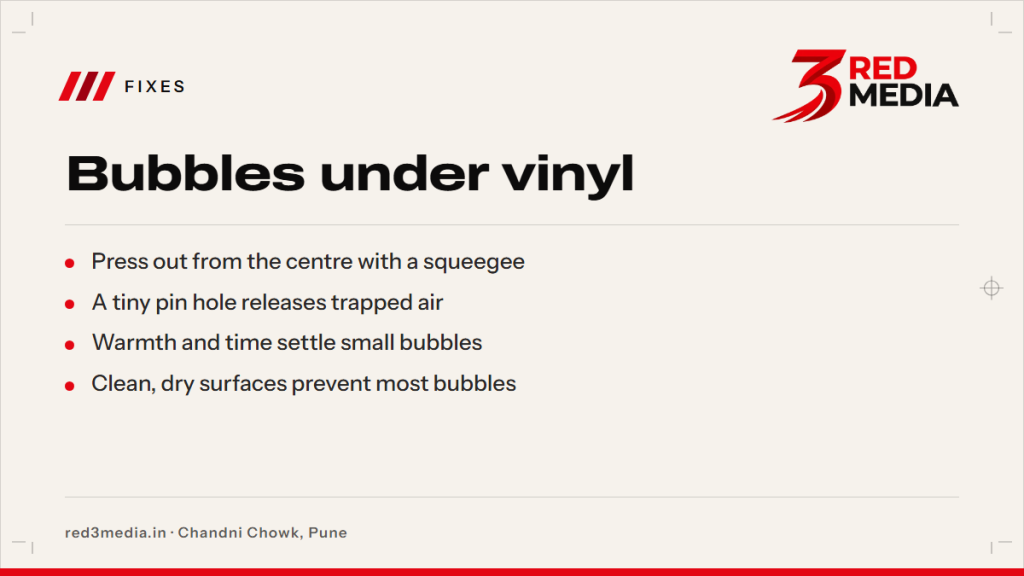
A tiny pin hole can release trapped air from a small, isolated bubble. Make only a pin-sized hole, then press the air out gently. This is a last-resort repair: it can leave a visible mark and is not suitable for every film, print or surface.
Can I pop a bubble with a pin?
You can try a tiny pin hole on a small bubble in ordinary adhesive vinyl, then ease the air out with gentle pressure. Keep the hole as small as possible and do not puncture close to printed detail, lettering edges or a seam where the opening may show more.
Do not use a pin automatically on window film or vehicle wraps. The film may be stretched, layered or fitted with a particular method, and a puncture can damage the finish. If you are unsure what type of film you have, ask the supplier or installer before making a hole.
Why do bubbles appear days after fitting?
A bubble that appears later can point to dust, moisture or residue left under the vinyl. Heat can also soften the film and adhesive, making an existing pocket easier to notice. On glass, strong afternoon sun can warm west- or south-facing areas, which may make a fitting issue more visible.
Check whether the bubble is growing, moving or surrounded by a raised edge. A few small bubbles may settle as the vinyl adheres, but trapped dirt will remain visible and can prevent a smooth finish. Avoid repeatedly pressing or heating a large area, because that can stretch the film or affect the print.
For details about outdoor use and care, read how long vinyl lasts. A suitable finish and regular surface care help, but no fixed lifespan can be promised for every location.
How do I prevent bubbles on large vinyl?
Preparation does most of the work. Clean the surface with a method suited to its material, remove grease and dust, and let it dry fully. Check for chips, rough patches, loose paint or deep texture, since vinyl may not sit evenly over them.
For a large graphic, position and secure it before peeling away the backing. Apply a manageable section at a time, smoothing from the centre towards the edges with steady overlapping strokes. Keep the vinyl flat rather than pulling it tight, especially around corners and curves.
Use this quick check before fitting:
| Check | Why it helps |
|---|---|
| Surface is clean and dry | Reduces dust, grease and moisture under the film |
| Graphic is aligned first | Avoids lifting and repositioning the whole piece |
| Film is applied in sections | Makes it easier to smooth air towards an edge |
| Pressure is even | Helps the adhesive contact the surface consistently |
We print vinyl graphics at 3 Red Media, with the print unit at Chandni Chowk, Pune. If the artwork needs preparing, see how to send artwork. Large formats and specialist films may need a suitable fitter; fitting can be arranged, ask when you send the size.
For film on glass, our one way vision printing page explains how perforated film works. For vehicle panels, see vehicle wraps in Pune, where curves and panel edges need particular care.
Do air-release channels in vinyl help?
Some vinyl films have small channels in the adhesive that give trapped air a path to escape during application. They can make fitting easier on suitable jobs, especially larger graphics, but they do not remove the need for a clean surface or careful squeegee work.
Not every vinyl has these channels, and the feature is not a cure for bubbles caused by dirt, moisture, tension or an unsuitable surface. Ask what material is being used for your application and follow its fitting instructions.
Send the finished size, surface details and artwork through our vinyl quote form. We will share a price and digital proof for approval before printing.