Reflective sticker vs normal vinyl comes down to what happens when a headlight hits it. Reflective vinyl sends most of that light straight back towards its source, so a sign or a vehicle edge looks bright to the driver at night. Normal vinyl only shows the light that falls on it, so after dark it looks as dim as the surface around it.
Day and night are the real test of reflective sticker vs normal vinyl: by day the two look alike, but after dark only one is easy to see.
Reflective sticker vs normal vinyl: what is the difference?
Normal vinyl is a printed or coloured film that scatters light in every direction, the way paint does. Reflective vinyl hides a layer of tiny glass beads or moulded prisms under a clear face. Those lenses catch incoming light and send it back along the path it came from instead of scattering it.
| Normal vinyl | Reflective vinyl | Glow-in-dark film | |
|---|---|---|---|
| Night visibility | As dim as the surface around it | Bright when headlights hit it | Faint glow that fades in hours |
| Light needed | Any light on it | Light from the viewer’s own side | Charges in light first |
| Typical use | Branding, windows, stickers | Vehicles, road and safety signs | Exit signs, novelty stickers |
How does reflective vinyl work at night?
The effect is called retroreflection. A headlight beam enters the film, bends through the beads or prisms, and leaves almost parallel to the way it arrived. A driver sitting just above the headlight is close to that return path, so the film seems to glow, while someone standing off to the side sees much less.
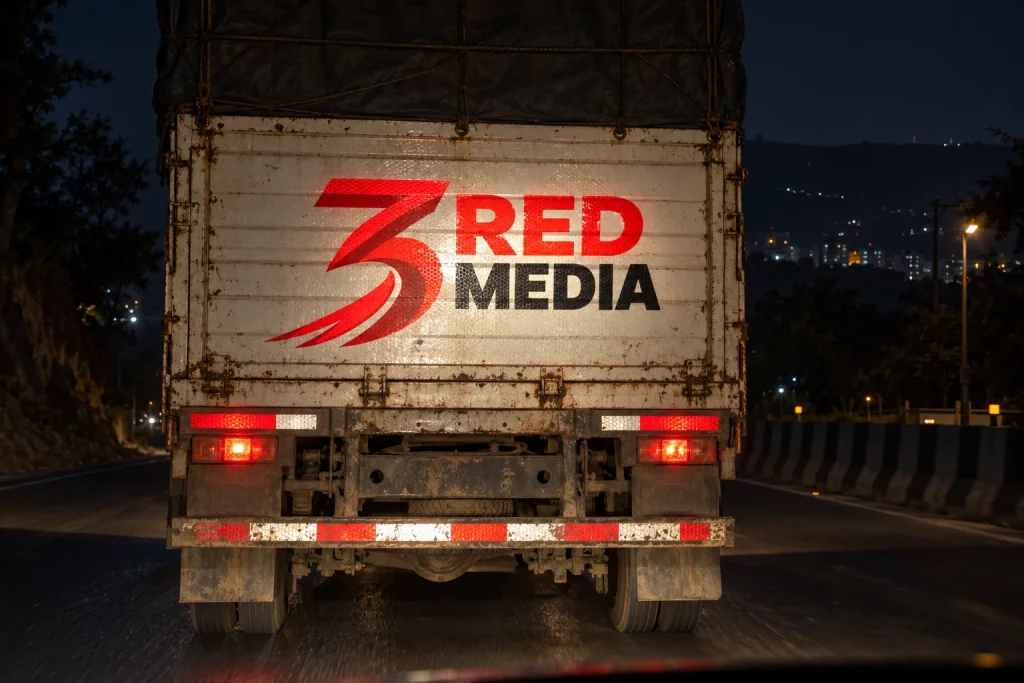
Night reflective vinyl still needs a light source. With no headlight, torch or streetlamp on the viewer’s side, it looks like ordinary film. Brightness also depends on the grade: engineer grade is the entry level, high-intensity prismatic is brighter, and diamond grade is brighter again, with the types set out in the ASTM D4956 standard. Highway signs tend to use the upper grades.
Where is reflective vinyl used: vehicles, signs, helmets?
- Trucks, trailers and buses, where reflective tape of a set type is required.
- Delivery vans and bike boxes, as stripes or a logo outline along the rear.
- Gate, car park and ramp signs, built as described under sign board printing.
- Helmets and bags, as small stickers that catch headlights.
- Bollards and ramp edges in basements and factory yards.
You rarely need to cover a whole surface. A band or a border does the job, because the eye picks up the outline of a vehicle or a gate sign from its edges.
For commercial vehicles, reflective tape is a legal matter as well as a visibility one. Rule 104 of the Central Motor Vehicles Rules, 1989 sets reflective tape requirements for certain goods and passenger vehicle categories and refers to the AIS-090 standard, and state transport departments such as those of Tamil Nadu and Punjab have asked for certified tape. Decorative reflective vinyl is not a substitute, so ask your RTO which tape your vehicle needs.
Graphics must also leave the number plate, the lights and any fitted reflectors clear. Fleet identity beyond tape is covered under vehicle branding.
Can reflective vinyl be printed in colour?
Partly. Reflective sheeting comes in white and in coloured versions such as red, yellow, blue, green and orange, and transparent inks can be printed over white sheeting on suitable types. Every colour layer reduces brightness: coloured areas return less light than white, and black returns almost none.
So design for the film. Use bold shapes and large letters, keep the main message in white or one sheeting colour, and avoid photographs and fine gradients. Reflective film is a specialty material, so say what it is for and what it will stick to when you request vinyl printing, and the film and method are confirmed with the proof.
Reflective sticker vs normal vinyl: which is more durable?
Both are made for outdoor use, so life depends on the grade and the place more than on the type. Reflective film has one extra weakness, its optics. Scratches, a coat of road dust and the wrong laminate cut the returned light long before the colour fades, which is why road signs are cleaned. Normal vinyl simply fades slowly from the colour side. Position matters too: film on a horizontal surface tends to collect dust faster and lose brightness sooner than film on a vertical face.
Wash reflective stickers with water and a soft cloth, because abrasive pads and solvents scratch the lens layer. An ordinary laminate can dull the effect, so ask which overlay suits the film.
When is normal vinyl enough?
Whenever nobody needs to see the sticker from a moving vehicle in the dark. Shop windows, indoor walls, office doors and most branding in lit areas are well served by normal vinyl, which also gives the full range of colours and finishes. A practical mix is normal vinyl for the message and reflective trim for the outline.
| Where it goes | Choose |
|---|---|
| Lit shop front, indoor wall | Normal vinyl |
| Society gate on an unlit lane | Reflective, or a reflective border |
| Delivery van on night runs | Normal graphics plus reflective trim |
| Truck, trailer or bus | Tape that meets the rule above |
Small stickers for bikes and helmets sit between the two, and vinyl sticker printing covers the sizes. 3 Red Media prints stickers and signs at its Chandni Chowk unit in Pune. If the reflective sticker vs normal vinyl choice is still open for your job, say what it is for on the quote form, along with the surface and size.