Vinyl printing uses cover almost any flat or gently curved surface that needs a name, a picture or a message: glass, walls, floors, boards and vehicles. Twenty of the most common are listed below, grouped by surface, with the kind of vinyl each one needs. If you want the basics first, what vinyl printing is explains how a design becomes a sticker or a wall print.
Look around any Pune street and you are already counting vinyl: the window of a mobile shop, the stripe on a delivery van, the arrows at a clinic entrance. Once you know what to look for, the uses sort themselves by surface.
What are the main vinyl printing uses?
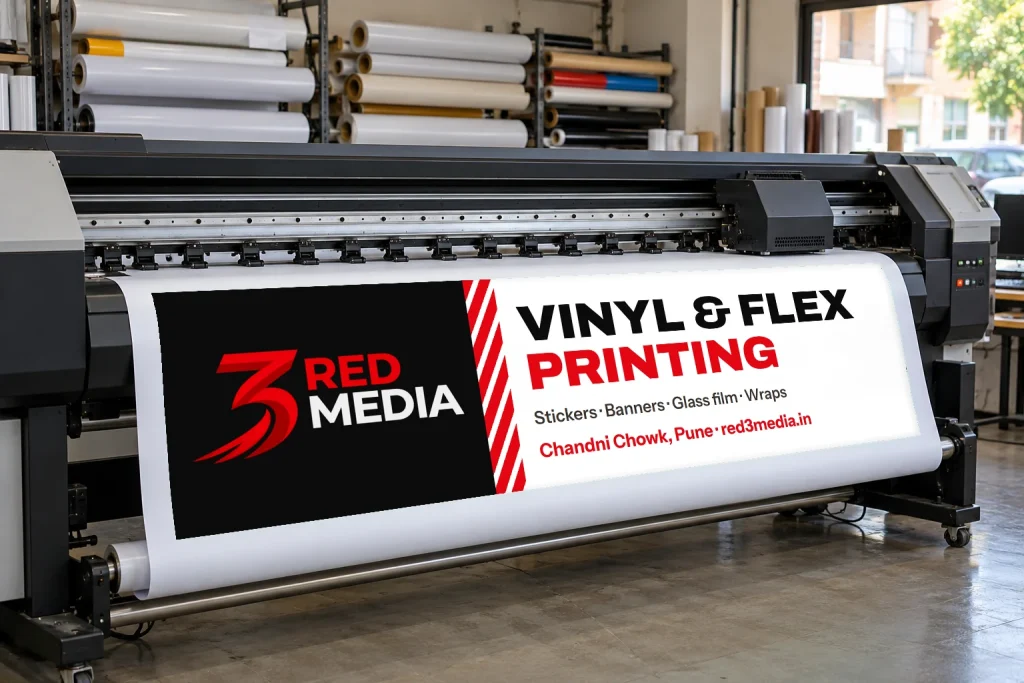
Six families cover almost everything. The table gives the quick view, and the twenty examples that follow fill it in.
| Surface | What vinyl does there | Usual film |
|---|---|---|
| Glass | Branding, privacy, safety marks | One way vision, frosted, cut lettering |
| Walls | Murals, brand stories, wallpaper | Printed wall vinyl, matt |
| Floors | Arrows, queue spots, zones | Printed vinyl, anti-skid laminate |
| Vehicles | Fleet names, wraps, bike graphics | Vehicle-grade film |
| Boards and objects | Signs, labels, packaging | Printed vinyl on board or product |
| Events | Backdrops, stall walls, signs | Printed vinyl on boards and walls |
Two things decide almost every choice: the surface under the vinyl and how far away the reader stands. A pane read from across the road wants bold shapes and a tough film. A wall read from two feet away wants fine detail and a matt laminate.
Where is vinyl printing used on glass and windows?
Glass carries more vinyl printing uses than any other surface, because it is the most visible part of a shop or office. Note which face of the glass you can reach before ordering, since film fitted on the inside is printed mirror-reversed so that it reads correctly from the street.
- Shop-window graphics. A large print in one way vision film puts the brand on the whole pane, while staff inside still see the street. It suits street-facing showrooms, salons and cafés.
- Door lettering. Timings, the shop name, push and pull marks and payment logos are cut from coloured vinyl, so only the letters sit on the glass and the background stays clear.
- Privacy bands. Frosted film at eye level on cabins, clinic rooms and washroom windows blurs the view but still lets daylight through, and it peels off cleanly when the room changes use.
- Glass-door safety marks. A strip, a row of dots or a logo at eye height makes a clear door visible before someone walks into it, which matters in busy offices and showrooms.
- Seasonal window displays. Sale and festival messages go up for Ganeshotsav, Navratri or Diwali and peel off when the season ends, so one pane can carry a new campaign each quarter.
In Pune, west-facing panes take the afternoon sun. Frosted and clear film fitted on the inside face is shielded from rain and ages slowly, while one way vision normally goes on the outside and fades sooner.
How is printed vinyl used on walls and floors?
Vinyl printing uses on walls and floors come with a catch: people stand close and walk across them, so sharpness and the surface underneath matter more than anywhere else.
- Brand walls. A logo, tagline or company story is printed in panels and fitted behind a reception desk or along a corridor, as described under wall graphics.
- Wallpaper-style murals. A feature wall in a café, bedroom or consulting room is printed to the exact wall size, so the pattern or photograph runs without a break.
- Floor arrows and queue marks. Printed vinyl under an anti-skid laminate guides patients, shoppers and visitors to the right counter. Plain glossy vinyl should never be laid on a floor.
- Classroom and coaching-centre walls. Maps, alphabets, formulae and toppers’ boards are printed once and replaced each year, which is faster than repainting a wall.
Walls need smooth, fully cured paint, and floors need to be clean and dry. Textured or damp surfaces are better served by a printed board fixed in front of them.

What are the uses of vinyl printing on vehicles?
Among vinyl printing uses, vehicles are the ones that live outdoors every day. Vehicle-grade film is softer than wall vinyl and stretches around curves, which is why it is chosen for body panels.
- Fleet names and numbers. Vans, tempos and delivery bikes carry the same layout down the line, so a ten-vehicle fleet needs one design repeated, not ten.
- Partial wraps. The doors and rear panel of a company car can carry a printed band, with the original paint showing around it.
- Scooter and bike graphics. Tank panels, mudguards and helmets take cut or printed vinyl, which lets owners change the look without repainting.
- Auto-rickshaw and delivery-box panels. Space is tight, so a name and a number in large type do most of the work.
Rules on colour changes, number plates and glass apply to every vehicle job, and the vehicle branding page lists the points to check before ordering.
Which vinyl printing uses are common for shops and offices?
Inside a business, vinyl does quieter jobs than it does in the window, but it does more of them.
- Name boards. Printed vinyl on ACP or sunboard gives a flat, sharp fascia, and the Marathi name can be planned in from the start.
- Counter and shelf graphics. Counter fronts, shelf strips and offer zones lead a customer from one product to the next without a word from staff.
- Cabin, room and department signs. Cut lettering on glass or vinyl on sunboard plates keeps every sign on one layout, which makes a large office easier to read.
- Labels and packaging. Waterproof stickers on jars, boxes, bottles and delivery bags can be cut square or to shape, and they stand up to damp hands and wiping.
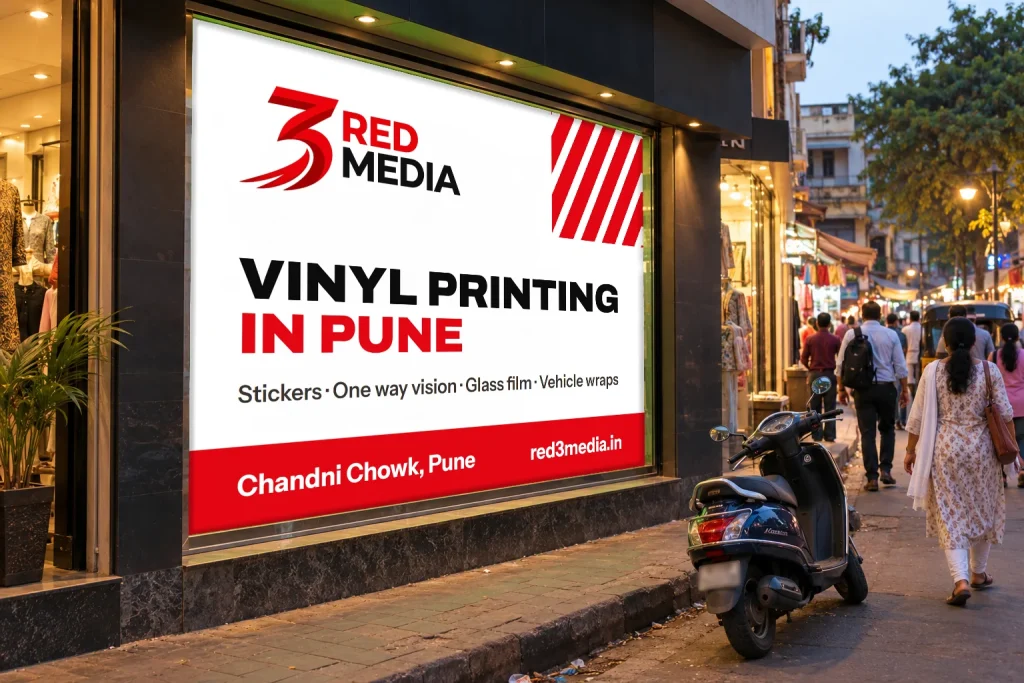
A single frontage often uses four of these together: a vinyl board overhead, film on the big pane, lettering on the door and a sticker by the counter. Keep the same colours and fonts on every piece, so the board outside and the sticker inside read as one brand.
Which vinyl printing uses suit events and exhibitions?
Event vinyl is short-term, so it is chosen for speed and for how cleanly it comes off afterwards.
- Exhibition stall walls and counters. Printed panels cover the back wall and the counter front, and a floor graphic marks the edge of the stall.
- Photo walls and selfie boards. Vinyl on sunboard, cut into frames and shapes, is light enough to carry to the venue and reuse at the next event.
- Wedding and party signs. Welcome boards, seating charts, mirror stickers and hashtag decals can all be printed in one matching style.
The date is fixed, so give it with the order, along with what each panel will be fixed to, such as painted board, laminate or glass, because vinyl grips each one differently. Urgent jobs are possible depending on size and queue, and the ready time is confirmed on WhatsApp.
How do I choose the right vinyl for each use?
Match the film to the surface first and the job second.
| If the vinyl goes on | Choose | Add |
|---|---|---|
| Glass you want to see through | One way vision or clear film | Laminate for sun-facing panes |
| Glass that needs privacy | Frosted film | Fit it on the inside face |
| Smooth, cured wall | Printed wall vinyl | Matt laminate |
| Floor | Printed vinyl | Anti-skid laminate |
| Vehicle | Vehicle-grade film | Laminate, fitted in shade |
| Sign or board | Vinyl on sunboard indoors, ACP outdoors | Laminate if it meets sun |
Whichever vinyl printing uses are on your list, answer four questions: indoors or outdoors, how long it must last, how close people stand, and whether it will be touched or wiped. Close and handled means laminate. Far away and weather-exposed means a tougher film and a sheltered spot where possible.
Three mistakes come up again and again:
- Using wall vinyl on a floor, where it turns slippery and scuffs.
- Putting one way vision on a pane that must stay private after dark.
- Skipping the check on the surface underneath, which causes more peeling than any fault in the print.
Every product named above is listed on the vinyl printing page. 3 Red Media prints most of these vinyl printing uses at its Chandni Chowk unit in Pune, and fitting can be arranged. Send the surface, the size and your design through the quote form, and a proof comes back for approval before anything is printed.