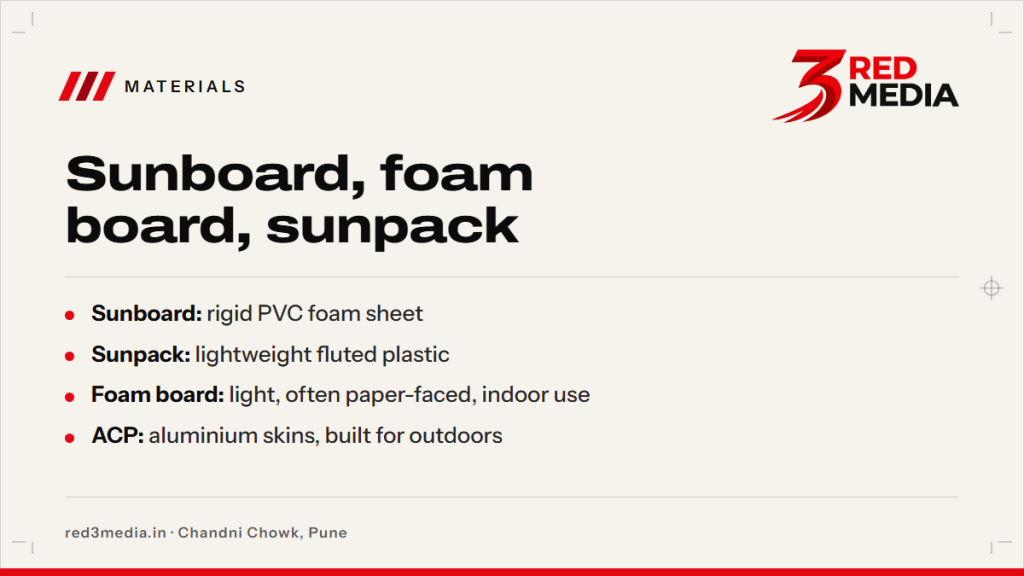
Sunboard vs foam board comes down to what sits inside the sheet. Sunboard is rigid PVC foam with a smooth plastic skin, foam board is usually soft polystyrene wrapped in paper, and sunpack is a third material altogether: hollow, ribbed polypropylene. For indoor signs and standees sunboard is the usual pick, while a board that stays outdoors in Pune needs ACP, the aluminium-faced panel.
The trouble is the names. Plenty of sellers say foam board and mean the same PVC sheet that others call sunboard, so the label alone settles nothing. The cut edge and the weight in your hand are more reliable.
Sunboard vs foam board: what is the difference?
Sunboard is closed-cell PVC foam. Elsewhere the same material is simply called PVC foam board. Cut a sheet and the edge shows a fine, even white core between two smooth skins, with no paper anywhere. It is stiff for its weight, does not soak up water and cuts cleanly with a knife or a saw, which is why sign makers use it for boards that must stay flat.
Foam board, in its usual form, is the sheet from school projects: a soft polystyrene core with paper glued to both faces. It is very light, but a thumbnail dents it, and damp makes the paper wrinkle and lift away from the core. That keeps it to short-term indoor displays.
Two quick tests settle sunboard vs foam board at any shop counter. Press a thumbnail into the face, then look at the edge. A hard skin and an even core mean sunboard, while paper and a spongy centre mean foam board.
| Board | Cut edge shows | Typical job |
|---|---|---|
| Sunboard (PVC foam) | Even white foam between plastic skins | Indoor signs, cut-outs, easel boards |
| Foam board (paper-faced) | Paper, soft white core, paper | One-off event signs, mock-ups |
| Sunpack (corrugated PP) | Hollow ribs running one way | Temporary boards, danglers |
| ACP (aluminium composite) | Thin metal skins around a plastic core | Outdoor fascia, long-term signs |
What is sunpack board and how is it different?
Sunpack is corrugated polypropylene: two thin plastic layers joined by ribs, so most of the thickness is air. A sheet weighs very little and flexes under a push, then springs back. That is why it survives rough handling on event days better than sunboard does.
The ribs have a cost. They can show as faint stripes through a thin vinyl face, so sunpack suits bold graphics more than fine photographs. The cut edge is open at the ribs, where water and dust get in. Plain polypropylene also tends to turn brittle after long hours in direct sun unless the sheet carries a UV additive, so treat sunpack as a short-term outdoor material.
Which is stronger: sunboard, sunpack or ACP?
Strength means three different things on a signboard, and each board wins a different one. ACP is the stiffest for its weight and the only one made for open air. Sunboard stays flat across a moderate span but takes a dent from a hard knock. Sunpack bends easily, yet it shrugs off knocks because it flexes and recovers.
Match the weakness to the place. A basement pillar is bumped by cars but never sees rain, so sunpack or a thick sunboard copes. A compound gate meets sun and monsoon wind every day, so ACP earns its higher cost.
Sunboard vs foam board for indoor signs
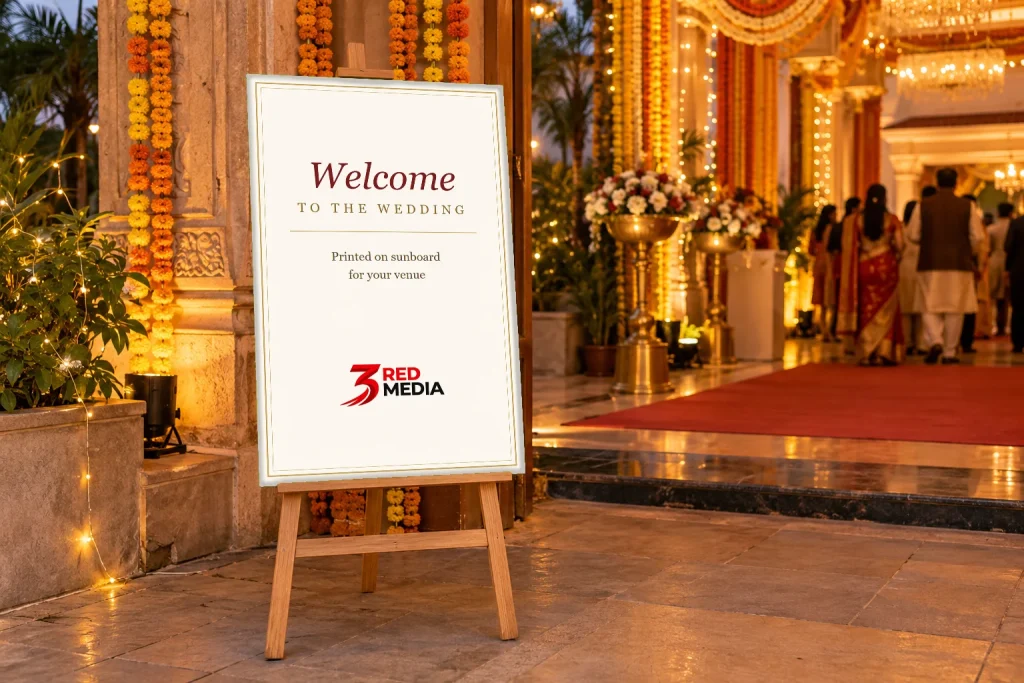
Office room plates, clinic department boards, wall charts and counter signs mostly use 5 mm sunboard with printed vinyl on the face, as described under sunboard printing. The surface stays flat, a matt laminate cuts the glare of tube lights, and the board fixes with foam tape or capped screws.
Paper-faced foam board makes sense only for a sign that will be thrown out after a day or a week. Sunpack suits a notice that changes often.
Which board suits standees and cut-outs?
A cut-out is a shape, so the board must cut cleanly and hold its edge. Sunboard from 5 mm up to 10 mm does both, with a folding prop behind to keep it upright. Life-size party cut-outs that last one evening are often paper-faced foam board, simply because it is light to carry.
Roll-up standees sidestep the question: the print is a flexible film and the base does the standing. The types are laid out under standee printing. Tall figures tip over more often than they break, so give a cut-out a wide base and a prop that reaches about halfway up its back.
Which board survives outdoors in Pune?
Outdoors, sunboard vs foam board is not the real contest, because ACP is the board made for the job. Its aluminium faces do not bow in summer heat, rain runs off them, and the flat surface takes vinyl well. Sunboard belongs in sheltered spots such as a covered entrance, because direct afternoon sun can bend the sheet and monsoon splash leaves dirty marks along its edges. Paper-faced foam board should never leave the building.
Sunpack can last a few days of an outdoor event, then wind makes it flap and sun makes it brittle. For a shop name board facing the road, most owners choose flex on a frame or vinyl on ACP, and the choice is laid out under sign board printing. Whatever the board, ask for a laminate on the vinyl if it will meet sun.
How do I choose sunboard thickness: 3 mm or 5 mm?
Once sunboard vs foam board is settled, thickness is the choice buyers most often get wrong, because 3 mm and 5 mm sound close. Stiffness rises roughly with the cube of thickness, which makes a 5 mm sheet more than four times as stiff as a 3 mm sheet of the same board. That is the gap between a sign that sits flat and one that bows between two screws.
| Longest side of the board | Thickness to ask for | Typical job |
|---|---|---|
| Up to about 2 ft | 3 mm | Door plates, small notices |
| 2 to 4 ft | 5 mm | Office signs, easel boards, wall charts |
| Over 4 ft or free-standing | 8 to 10 mm, or ACP | Large cut-outs, frameless boards |
Full sheets typically come as 8 × 4 ft, so sizes that divide neatly into one, such as 4 × 2 ft or 2 × 2 ft, waste less material than odd sizes.
If sunboard vs foam board is still undecided for your job, tell the printer where the board will hang, its longest side and whether sun or rain will reach it, and the right sheet follows. 3 Red Media prints vinyl and mounts it on board at its Chandni Chowk unit in Pune. Send the size and a photo of the spot through the quote form, and a proof comes back before anything is printed.