Warehouse floor marking uses visible lines, labels and symbols to identify aisles, storage bays, work areas and restricted zones. We print floor marking stickers to suit a planned layout, after you share the sizes and design and approve a digital proof.
Vinyl markings can be useful where a team needs clear visual cues on the floor. Surface condition, wheel traffic, cleaning and the choice of adhesive all affect how well they hold, so check these before settling on a material.

What is warehouse floor marking?
Warehouse floor marking is a visual system laid out on the floor to guide movement and identify areas. It may include aisle boundary lines, bay numbers, directional arrows, equipment parking outlines, pedestrian routes or warning symbols. The markings work best when their meaning is agreed across the team and kept consistent throughout the premises.
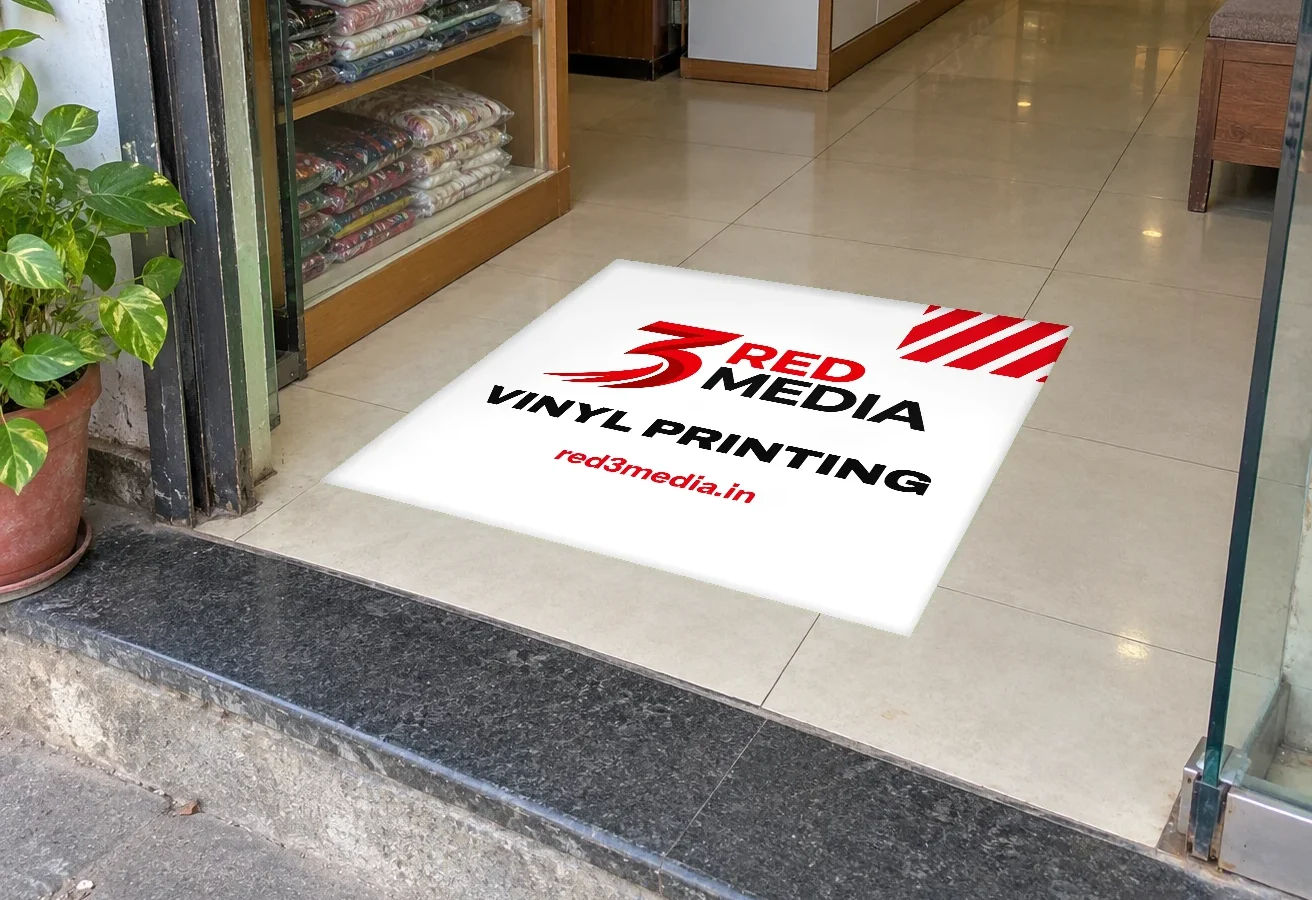
A floor sticker is one way to make that system. A printed vinyl graphic can carry a short label, number, arrow or symbol in a defined shape. For a complete layout, first note the routes people and equipment use, then mark the exact positions and dimensions on a simple floor plan.
Are floor marking stickers better than paint?
Stickers and paint suit different situations. Stickers can be printed with text or symbols and applied in defined shapes, while paint is commonly used for lines and larger areas. Paint involves surface preparation and application on site. A vinyl sticker is printed first and then applied to a suitable clean, dry floor.
Consider the time and disruption involved in preparing the floor, the detail needed, how often the layout might change and what cleaning the area receives. A sticker may be convenient for a label or symbol, but constant heavy wheel traffic can wear its edges. Paint may be more practical for some long line runs, depending on the floor and site work.
For a vinyl option, send us the size, floor type, traffic conditions and artwork. We can prepare a digital proof for approval before printing. Check floor graphics in Pune for examples of how printed floor visuals can be used.
Which colours are used for aisles and hazard zones?
There is no single colour code that every warehouse must follow in every situation. Businesses often choose contrasting colours so that aisle boundaries, pedestrian areas, storage bays and hazards are easy to tell apart. Agree what each colour means with the people who use the site, then keep that system consistent.
Use contrast against the floor and keep text or symbols large enough to recognise from the usual viewing distance. A sample or proof can help the team review colour and legibility before production. If markings relate to workplace safety or site rules, check the relevant guidance with the responsible authority or safety professional.
| Marking purpose | Planning point |
|---|---|
| Aisle boundary | Keep the route clear and easy to follow |
| Storage bay | Use a readable bay number or label |
| Pedestrian route | Make the route distinct from equipment paths |
| Hazard or restricted zone | Use a consistent symbol and colour agreed for the site |
Office and workplace branding can also use floor graphics for wayfinding, though warehouse markings should be planned around the movement and tasks at that site.
What floors hold floor marking vinyl: epoxy, concrete, tiles?
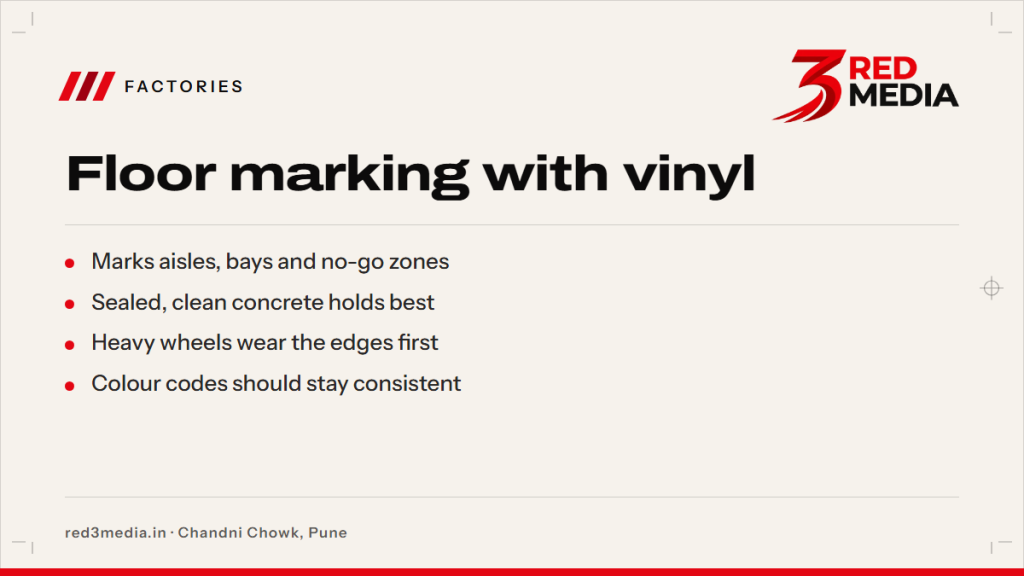
The condition of the surface matters as much as its name. Sealed, smooth, clean concrete is generally a better starting point than dusty, porous or uneven concrete. Epoxy-coated floors and tiles may also be suitable when the surface is sound, dry and clean, but coatings, grout lines, texture and cleaning residue can affect adhesion.
Before ordering, inspect the area for cracks, loose coatings, oil, moisture and dust. Clean using a method suitable for the floor, then allow it to dry fully. If there is doubt about the surface or adhesive, test a small sample in a low-risk area and observe how it behaves under normal use.
3 Red Media operates its print unit at Chandni Chowk, Pune. We print vinyl graphics from customer-supplied sizes and designs, then share a digital proof so you can review it before anything goes to print.
How do forklifts and trolleys affect floor stickers?
Wheels put repeated pressure on the sticker surface and its edges. Forklifts, pallet trucks and loaded trolleys can scrape, turn or brake over markings, so edges on busy routes may wear sooner than markings in a quiet bay. Dust and water brought in by wheels can also affect the floor and the sticker bond.
Think about where wheels turn, stop and cross the marking. Avoid placing small text or critical symbols where they will be hidden by parked goods or repeatedly scraped by equipment. Choose a size and position that remain visible while allowing the normal movement of stock and staff.
Cleaning practices matter too. Follow the floor-care instructions for the site, and avoid aggressive scraping across sticker edges. No printed floor marking has a guaranteed lifespan: actual wear depends on traffic, surface preparation, cleaning and use.
For industrial areas around Chakan or Pirangut, the same checks apply: map the routes and floor condition at the actual site rather than assuming two premises will behave alike. See vinyl printing in Chakan and vinyl printing in Pirangut for local service information.
How do I plan a floor marking layout?
Start with a current floor plan and confirm the dimensions on site. Mark the aisle widths, bay positions, pedestrian routes and any restricted areas. Note where doors, columns, racks and equipment paths affect visibility. If fabrication or installation is needed, send the size so we can say whether it can be arranged for your job.
- List each marking and its purpose, such as aisle line, bay label or warning symbol.
- Measure the available area in feet and inches, and record the intended sticker dimensions.
- Check the floor finish, surface condition, cleaning routine and wheel traffic at each position.
- Keep colours, symbols and wording consistent, and review them with the people who use the space.
- Send the layout and artwork for a digital proof, then approve the proof before printing.
For print preparation, provide clear artwork and the finished dimensions. If your design is not ready, include the text and symbols needed so the layout can be reviewed. The artwork preparation guide explains what to send. We deliver across Pune and PCMC, and can courier orders elsewhere in India with the courier charge added to the quote.
Measure and check the floor first. We print only after you approve the digital proof.
Send the size, surface details, traffic notes and artwork through the quote form to receive a quote and digital proof.