One way vision for office use works well on street-facing ground-floor glass, where it gives the road a printed brand face and still lets staff see out in daylight. It does not make cabins private, and after dark, once the office lights are on, the effect fades. For those rooms, frosted film is the safer choice.
Think of the film as a printed screen with a great many small windows in it. The street reads the picture, while staff read the street through the gaps.
Is one way vision for office glass a good idea?
Yes, in the right place. Offices have two kinds of glass: glass that faces the public, such as a ground-floor frontage or a reception on the road, and glass that faces other staff, such as cabins and partitions. One way vision belongs on the first kind. It puts a brand on a plain frontage, softens glare on the desks beside it and stops passers-by from studying the room in daylight.
On the second kind, the view through the partition is the point, and frosted film does the privacy job better. Most offices end up using both films, each on its own glass. The product notes are on the one way vision printing page.
Typical candidates are IT-park lobbies, co-working entrances, bank branches and road-side reception windows: anywhere a lot of glass faces a lot of passing people.
Will one way vision for office windows make the room darker?
A little, yes. The holes pass some light, and the printed face and its dark backing take the rest. The usual result is a tinted, calmer room rather than a dark one, much like sitting behind sunglasses.
How much depends on the share of holes. A film with more open area lets more light and view through but shows a fainter picture outside, while a more solid film does the reverse. Ask for the open area to be matched to the room.
West-facing offices in Pune feel the benefit and the cost together: less afternoon glare on monitors, but a dimmer room by evening. Task lights near the glass help. Glare drops, but heat gain is a job for solar-control film, which is a different product.
What can I print on one way vision for office glass: logo or pattern?
Both work, if they are bold. About half the film is holes, so fine lines and small text vanish. A large logo at eye height, a simple geometric pattern or a single brand colour with the logo left clear will read from across the road. Strong contrast carries furthest, such as a white logo on a deep brand colour.
- Logo and tagline: the logo big enough to read from the opposite pavement, with one short line below it.
- Pattern or colour field: a repeated shape or brand colour across the lower half of the pane, with the logo left clear.
- Opening hours and room names belong on cut vinyl on the door, not on the perforated film.
- Photographs lose detail on perforated film, so keep them large and simple.
Proof the design on a photo of your own frontage at true size. A logo should sit inside one pane, or be planned across the vertical bars between panes, instead of landing on a join by accident.
Does one way vision work for cabins, reception and meeting rooms?
| Office glass | One way vision? | Why |
|---|---|---|
| Ground-floor frontage | Yes | Brand face to the road, view kept |
| Reception on the road side | Yes | Cuts desk glare, adds the logo |
| Meeting room facing the street | Partly | Daytime privacy only; add blinds |
| Cabins and HR rooms | No | Frosted film holds at every hour |
Inside partitions need no printed face, because nobody reads them from the street, and one way vision there only dims the room. Use frosted film or a clear safety band instead. A boardroom on the road side can take one way vision for the day and a roller blind for evening presentations. Corporate office branding shows how glass fits into the wider fit-out.
Does one way vision for office use work at night?
The effect depends on which side is brighter. In the day, the street is brighter than the office, so the print reads and the glass hides the room. After dark with the lights on, the balance flips: the street is darker than the office, so passers-by can see in and the print looks faint.
Offices with late shifts or call-centre hours should plan for it. Fit blinds behind the film, add a frosted band at desk height, keep desks away from the street glass, or switch off the lights near the frontage when the room is empty. If you are unsure how the glass behaves, stand outside after 7 pm and look in.
How do I measure office glass for one way vision?
Office glass is bigger and more varied than shop glass, so measure with a sheet and a photo.
- Number each pane on a straight-on photo of the frontage, left to right.
- Measure the visible glass inside the frame for each pane, and note the vertical bars (mullions) and horizontal bars (transoms) between panes.
- Mark the door handles, locks, closers and push plates that the film must avoid.
- Note which face you can reach. One way vision usually goes outside, and anything above the ground floor needs safe access arranged with building management.
- Ask who controls the glass. In a leased office or a tech park, the landlord or facility team often decides what may be seen from outside.
Write the numbers into a short schedule with pane number, width, height, floor and notes. One schedule then serves the proof, the quote and the fitting day.
How is one way vision for office glass different from frosted film?
| Question | One way vision | Frosted film |
|---|---|---|
| Shows a brand to the street | Yes, strongly | Only as cut shapes |
| Privacy at 2 pm | Good from outside | Good from both sides |
| Privacy at 9 pm, lights on | Weak | Same as by day |
| View out for staff | Tinted but clear | Blurred |
The shorthand: one way vision is for being seen, and frosted film is for not being seen. A wider comparison, with clear vinyl added, is in one way vision vs frosted film, and cut patterns for bands are under frosted glass film. Some offices use both on one frontage, with one way vision above and a frosted band at desk height.
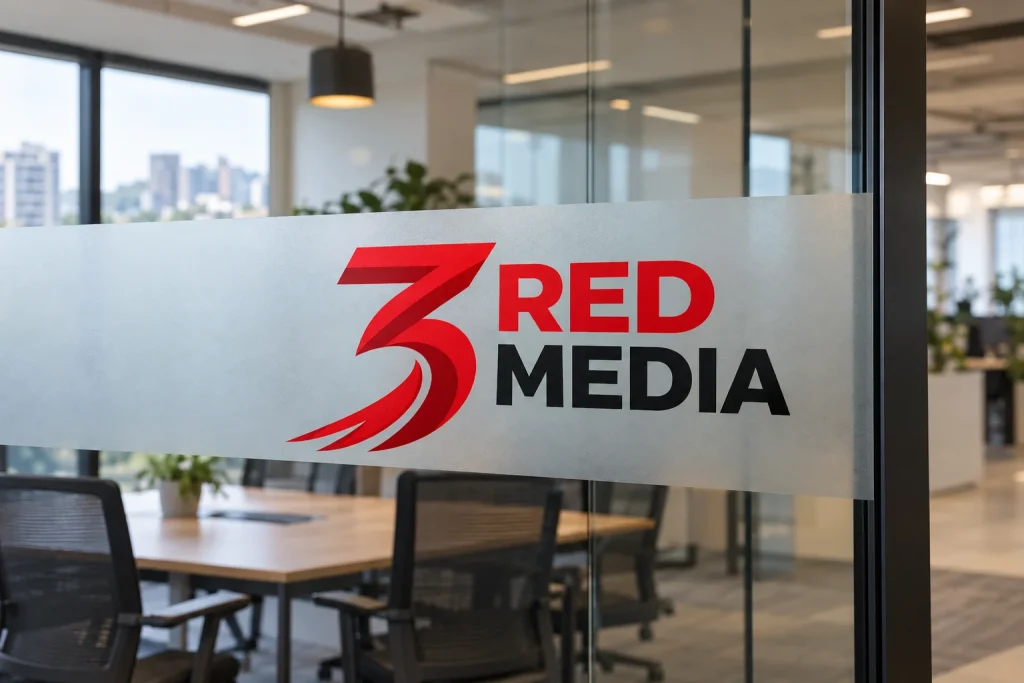
If the glass in question is the entrance itself, one way vision for glass doors covers handles, push plates and how the film behaves on a door that is opened all day.
3 Red Media prints one way vision film at its Chandni Chowk unit in Pune, and fitting can be arranged. Send the pane sizes, a frontage photo and the logo through the quote form, and the proof shows the film laid onto your own glass before anything is printed.