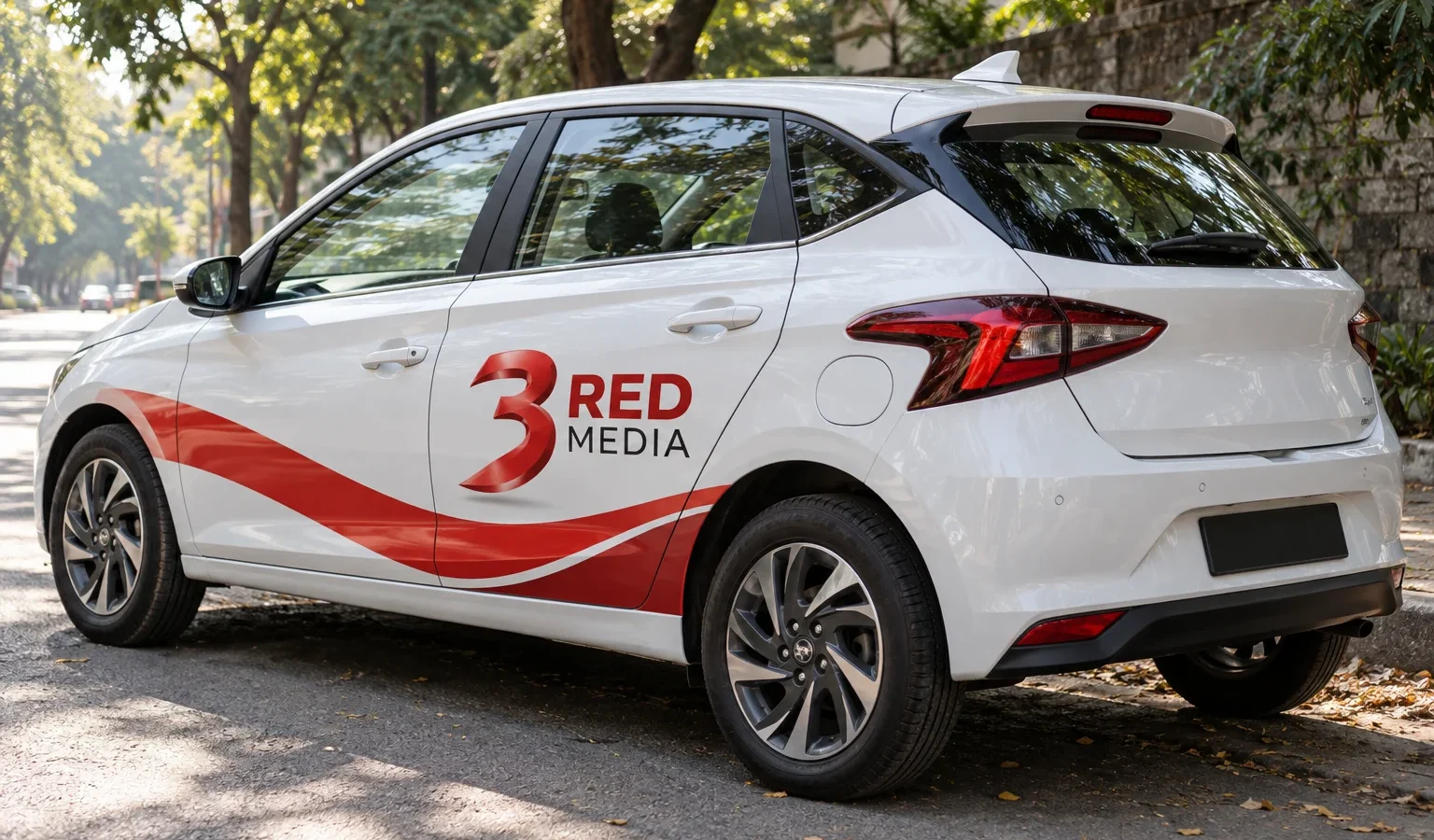
You can pressure wash vinyl wrap, but treat it as a last resort and keep the settings gentle: low pressure, a wide 40-degree nozzle, the nozzle at least 12 inches (30 cm) from the edges, and the jet square on to the film, never along an edge. A hand wash with mild soap is safer for a wrapped car, bike or vinyl sign. The danger is water forced under the film, which lifts edges and shortens the life of a wrap.
The figures here come from a major film maker’s care bulletin (Avery Dennison’s Instructional Bulletin 1.50, revised June 2024), which says a power washer should be used only when other cleaning methods have not worked. Your own film may come from another maker, so ask the fitter for its care sheet.
Can you pressure wash a vinyl wrap?
In principle yes, but the bulletin ranks it last. Its order of preference runs from a waterless wash to a hand wash to a spray-only car wash, with the pressure washer at the end. A jet can lift edges and wear the surface even when it feels gentle, so the numbers in the next section are ceilings, not targets.
What pressure and distance are safe for vinyl?
Home machines are the usual problem. Light-duty pressure washers sold in India are commonly rated at about 100 to 120 bar, which is above what the bulletin allows, so read the rating plate before you start.
| Setting | Limit in the care bulletin | Why it matters |
|---|---|---|
| Water pressure | Below about 1,200 psi (around 83 bar) | More force pushes water under the film |
| Nozzle | 40-degree wide fan | Spreads the force over more area |
| Distance | At least 12 in (30 cm) from edges | A close jet acts like a blade at a seam |
| Angle | Square to the surface | A jet from the side gets under an edge |
| Water temperature | Below about 180°F (80°C) | Heat can weaken the bond |
Try a low-risk flat panel first and keep the jet moving.
Why do edges lift under high pressure?
Vinyl holds firmest across its middle and weakest at its edges, where only a thin line of adhesive faces the outside. A hard jet slips water into that line, the bond weakens and the corner curls. Dirt then collects in the gap and the lift spreads.
The risky places are the same on every vehicle: door edges and handles, mirror caps, the lower edge of a bumper wrap, seams where two panels meet and any deep recess where the film is stretched. A fresh wrap is more delicate still, because the adhesive keeps strengthening after fitting. Ask the fitter how long to wait before the first wash.
How should I wash a wrapped car or bike?
- Rinse loose dust and mud off first with a gentle hose, working from the roof down.
- Wash with a mild car shampoo close to neutral in pH (the film maker’s range is 5 to 9) and a soft mitt, top to bottom, without scrubbing.
- Rinse well, then dry with a microfibre cloth or a soft squeegee so water spots do not bake onto the film.
- Clear bird droppings, insects, tree sap and fuel spills quickly, since they can stain the film if they sit.
- Keep solvents such as acetone and thinner away, and test any new cleaner on a hidden patch first.
The same bulletin suggests a wash roughly every two weeks, which suits Pune’s road dust and monsoon mud. On a bike, keep the jet off the tank, mudguards and side panels, and tell the roadside wash point to skip the graphics. Roofs and bonnets take the most sun, so parking in shade matters as much as washing. More on wraps themselves is on the car and bike wrap page, and on lifespan in the vinyl durability guide.
Are automatic car washes safe for wrapped cars?
The bulletin accepts a touchless wash that only sprays. The brush type is not recommended, because bristles can scratch the surface and catch an edge. Many service-station washes in Pune use a foam lance, a strong jet and a brush, so ask what the machine does before you drive a wrapped car in.
Skip the wax or polish options as well, since some waxes contain solvents that harm the film.
How do I wash vinyl signs and boards outdoors?
Vinyl on a shop board, sunboard or glass faces the same dust, sun and rain as a car, and the same rules apply. Use a hose on a gentle setting or a bucket and soft cloth, top to bottom, and keep the jet well back from the border of the vinyl and the joins between panels. For a high board, a long-handled soft mop is safer than a ladder and a pressure washer.
Perforated films need extra gentleness. A jet can drive water and grit into the holes and under the edge, so a light rinse and a soft wipe are enough. Vinyl stuck to a painted wall can peel if water gets behind it, so keep the spray off its edges too. Commercial vans and fleets follow the same routine, as the vehicle branding page explains.
A faded or lifted panel can be reprinted rather than replaced. Reprints are made in-house at the 3 Red Media unit in Chandni Chowk, Pune, and a photo plus the panel size sent through the quote form is enough to start.